Jumbo Roll Scrim Backing Fabric

- All
- Product Name
- Product Keyword
- Product Model
- Product Summary
- Product Description
- Multi Field Search
Views: 0 Author: Site Editor Publish Time: 2026-07-16 Origin: Site


The longevity and mechanical reliability of any vinyl composite fabric fundamentally rely on its hidden structural layer. Without a robust foundation, even premium surface coatings fail prematurely under stress. Premature delamination, stretching, and tearing in commercial applications usually stem from poorly specified backing rather than the vinyl coating itself. Engineers and procurement teams often overlook this crucial interface layer. This oversight leads to catastrophic field failures, delayed project timelines, and significant material waste on the production floor.
This guide provides a technical framework for evaluating and selecting substrates. You will learn how to specify optimal materials for industrial, commercial, and architectural composite applications. We explore critical variables like yarn denier, thread count, and thermal stability. By understanding these mechanical properties, you can select the precise architectural layer needed to ensure long-term structural integrity. Read on to master the technical specifications necessary for flawless material procurement.
Structural Integrity: Woven mesh backing provides the critical dimensional stability ("accurate shape control") necessary to resist tensile, shear, and compressive forces.
Specification Variables: Selecting the correct vinyl composite backing requires balancing yarn denier, mesh density (e.g., 9x9 vs. 18x18), and fabric weight against final application demands.
Risk Mitigation: Thermal shrinkage during lamination and poor adhesive strike-through are primary failure points that must be addressed during material selection.
Compliance Dependency: High-stress applications require specific chemical treatments, including ASTM E-84 Class A flame retardance, UV resistance, and anti-microbial properties.
Polymer matrices alone lack internal reinforcement. They warp easily under external physical stress. Without a stable substrate, shape distortion becomes inevitable over time. You cannot rely on the surface polymer to bear mechanical loads independently. It needs a hidden structural spine. A poorly supported polymer layer will stretch under tension and eventually rupture. This inherent weakness requires manufacturers to embed a stabilizing matrix into the core of the product.
Manufacturers often debate between woven and knit structures. We consistently select woven materials for heavy-duty applications. Woven materials offer minimal stretch. They deliver maximum sturdiness. Knit fabrics introduce unwanted elasticity due to their interlocking loop design. They compromise the dimensional stability needed for industrial goods. Woven backings serve inelastic requirements perfectly. Maintaining rigid structural shape remains non-negotiable for commercial roll goods.
Mechanical force distribution explains the superiority of woven architectures. A continuous filament woven mesh backing intercepts physical strain immediately. It disperses bending and shear deformation efficiently across its warp and weft yarns. The mesh absorbs these extreme physical forces before they reach the fragile outer layer. This internal force distribution prevents localized surface cracking. It ensures the composite endures heavy, repetitive physical abuse in the field.
Yarn denier directly impacts the ultimate tensile strength of your substrate. Denier measures the mass in grams of 9,000 meters of the yarn. Choosing a 500 denier versus a 1000 denier yarn changes everything about the final product behavior. Higher denier increases load-bearing capacity significantly. However, it also dictates a thicker, heavier final composite profile. Engineers must evaluate if the added structural bulk serves the application or simply hinders flexibility.
Mesh density and thread count dictate both strength and permeability. Industry-standard configurations typically include 9x9, 9x12, and 18x18 mesh grids. Higher density yields exceptional puncture resistance. It creates an almost impenetrable barrier against sharp objects. Conversely, an open weave structure reduces overall composite weight. It greatly improves adhesive penetration during continuous manufacturing. You must balance puncture resistance against lamination efficiency. A denser weave might block essential chemical bonding entirely.
Weight efficiency represents a constant balancing act for product engineers. Standard weights often hover around 43 g/m² or utilize varying ounces per square yard (oz./psy) metrics. You have to balance lightweight design needs against operational durability. Excess weight complicates handling and field installation. Too little weight invites premature failure.
Mesh Density vs. Performance Characteristics | ||||
Mesh Density (Warp x Weft) | Puncture Resistance | Adhesive Strike-Through | Flexibility | Typical Application |
|---|---|---|---|---|
9x9 | Moderate | Excellent | High | Lightweight Banners |
9x12 | Good | Very Good | Moderate | Commercial Wallcoverings |
18x18 | Exceptional | Low/Moderate | Low | Heavy Industrial Tarps |
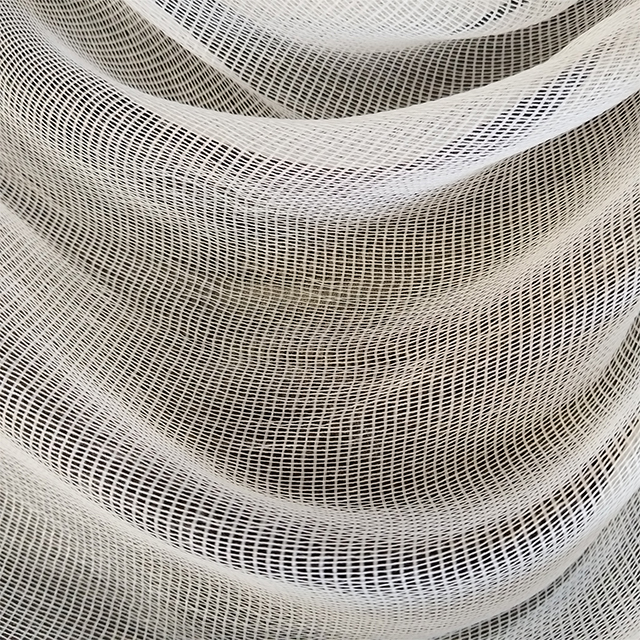
You cannot use a universal substrate for diverse industrial products. Every distinct application requires a precisely matched mesh backing material. Tailoring the specifications ensures optimal field performance and prevents costly manufacturing defects.
Architectural Wallcovering Scrim: A specialized wallcovering scrim demands zero stretch. It requires absolute dimensional stability and exceptional lay-flat properties. Consistent thickness prevents visual surface defects on smooth interior walls. Any fluctuation in the substrate telegraphs immediately through the thin vinyl face. Installers despise materials prone to edge curling. A tightly controlled scrim eliminates this frustrating behavior.
Laminated Commercial/Industrial Textiles: PVC tablecloths, flexible ducting, and automotive upholstery see frequent flexing. They benefit immensely from a high-strength polyester woven mesh. This fabric tolerates repetitive folding gracefully. It endures localized pressure without suffering internal fiber fracture. Durability matters most when consumers interact daily with the textile.
Heavy-Duty Exterior Covers: Truck tarps and tensile structures face severe environmental abuse. They demand maximum tear strength to survive. Open-weave designs prevent moisture trapping inside the protective matrix. They maintain profound structural integrity under extreme wind loads and violent weather conditions. These covers cannot stretch or tear under continuous outdoor tension.
High-temperature manufacturing processes pose severe risks to unstable fabrics. The manufacturing lines often run at temperatures exceeding 200°C. Your specified mesh must exhibit phenomenally low shrinkage. If the fabric shrinks during hot PVC coating, the entire roll warps irreparably. Thermal stability ensures the fabric remains perfectly flat after the lamination cycle cools down.
Adhesion and delamination risks plague careless specifiers constantly. Weave openness entirely dictates the physical and chemical bond. If you specify a weave too tight, adhesive strike-through fails. The distinct layers simply peel apart under minor stress. If you specify a weave too loose, the vinyl matrix lacks sufficient foundational grip. You must engineer the exact open-area percentage for your specific liquid adhesive system. Do not guess the strike-through requirements.
Raw polyester often falls short for severe commercial environments. You must mandate specific chemical add-ons during the specification phase. Demanding exterior applications require highly engineered formulations. The vinyl composite backing must meet stringent regulatory standards to ensure public safety. You should consider several critical treatments:
Flame Retardance: Architectural products usually require ASTM E-84 Class A certification to pass building codes safely.
UV Resistance: Prolonged sun exposure degrades untreated polyester quickly. UV stabilizers prevent this catastrophic breakdown.
Anti-Fungal Properties: Moisture-rich environments invite mold growth. Anti-microbial dips protect the hidden substrate layer effectively.
Ignore flashy marketing claims completely. Demand verifiable mechanical data from all potential manufacturing partners. Shortlisted suppliers must provide documented tensile, compression, and shear testing results. You need objective laboratory proof of dimensional stability. A trustworthy factory happily supplies detailed specification sheets containing precise mechanical thresholds.
Evaluate operational efficiency on the factory floor carefully. Industrial buyers must assess available production roll lengths. Splicing causes incredibly expensive downtime on continuous coating lines. Stopping a massive lamination machine wastes material and labor. Capacities ranging between 2000m and 4000m minimize these costly production interruptions dramatically.
Off-the-shelf SKUs rarely solve complex engineering challenges perfectly. Prioritize manufacturers offering true custom engineering capabilities. Look for reliable custom slitting and specialized chemical bath treatments. Precise color-matching is often crucial for translucent vinyl composite fabric lines. A flexible supplier adapts their weaving process to match your distinct chemical requirements.
Establish a strict internal procurement protocol before placing large orders. You should mandate several next-step actions:
Request physical sample cards to inspect denier and weave tightness visually.
Order small test rolls specifically for factory trial runs.
Execute rigorous pilot tests to verify adhesive compatibility.
Confirm exact roll tolerances before committing to bulk minimum order quantities (MOQs).
Woven mesh backing represents the critical structural spine of your end product, not a simple commodity afterthought. Specifying the wrong substrate inevitably leads to severe product failures, widespread customer returns, and ruined brand reputation. The hidden layers ultimately dictate the visible performance.
Aligning thread count, denier, and thermal properties strictly with your specific manufacturing process guarantees success. This proven scientific method eliminates frustrating field failures. It significantly reduces long-term material waste on the factory floor. Follow these essential next steps to secure your supply chain:
Audit your current product failures to determine if substrate instability is the hidden culprit.
Update your internal material specification sheets to mandate strict tensile and thermal shrinkage limits.
Request updated, verifiable mechanical testing documentation from your current supply partners today.
Run a localized adhesive strike-through test comparing multiple mesh densities before launching new product lines.
A: Polyester woven mesh provides an exceptional tensile strength-to-weight ratio. It features minimal elasticity and excellent heat resistance. These physical properties combine to deliver the critical dimensional stability needed to prevent the final composite from stretching or tearing under heavy use.
A: The backing deeply impacts lamination through thermal stability and porosity. It must resist catastrophic shrinkage under high lamination heat. Furthermore, its specific "open weave" structure dictates exactly how well the liquid adhesive or molten PVC penetrates and permanently anchors to the substrate.
A: A wallcovering scrim is a highly specialized backing layer attached to interior decor fabrics. It requires minimal stretch to prevent the aesthetic vinyl face from warping, stretching, or tearing during tight installation and the natural thermal expansion or contraction of building walls.
A: Denier and density control the inverse relationship between flexibility and overall strength. A higher denier yarn and tighter mesh density yield a significantly robust, puncture-resistant composite. However, this dense configuration reduces drape flexibility and increases the overall weight of the material.


