Jumbo Roll Scrim Backing Fabric

- All
- Product Name
- Product Keyword
- Product Model
- Product Summary
- Product Description
- Multi Field Search
Views: 0 Author: Site Editor Publish Time: 2026-10-30 Origin: Site


The success of a large-scale 3D holographic illusion does not rely solely on the projector or the digital content. It hinges entirely on the optical physics of the projection surface. AV integrators, event producers, and exhibition designers frequently struggle to balance the invisible effect of the screen with the necessary image brightness. This structural challenge often results in washed-out visuals, poor contrast ratios, or visible screen borders that instantly ruin the illusion for the audience. Achieving a true volumetric appearance requires precise control over how photons interact with the physical barrier suspended in the air. Understanding the exact mechanics of light transmission, weave density, and material composition solves this problem. This guide deconstructs how these fabrics operate, the inherent trade-offs in their deployment, and how to evaluate materials for high-stakes live environments so you can execute flawless visual effects.
Optical Mechanics: Modern holographic illusions rely on specialized mesh that captures projected light while allowing background elements to remain visible, modernizing the traditional Pepper’s Ghost technique.
The Transparency/Brightness Trade-off: Current industry standards require balancing 70%–90% transmittance with high-density weaves (typically 28–36 threads/cm²) to achieve optimal gain without sacrificing the "floating" effect.
Material Selection: Polyester-based meshes dominate the market due to their high tensile strength, dimensional stability under tension, and flame-retardant properties.
Implementation Reality: Ambient light control, precise projector placement, and specialized content formatting are the most critical factors in a successful deployment.
To create a convincing 3D asset, the audience must perceive the projected image as existing in physical space. This requires the screen itself to disappear entirely from view, leaving only the illuminated subject. The fabric acts as a semi-transparent canvas, performing a delicate optical balancing act between light reflection and light transmission. The specific metallic or polymer coating on the threads reflects a calculated percentage of the projector's lumens toward the audience. Simultaneously, the microscopic gaps between the threads transmit the remaining light. This selective reflection allows physical objects, stage props, or live performers positioned behind the screen to remain perfectly visible, establishing the depth of field necessary for realism.
You can contrast this direct front or rear projection onto a vertical scrim with the traditional Pepper's Ghost technique. The older method required a cumbersome 45-degree angled bounce using heavy glass or tensioned foil, consuming massive amounts of stage space and requiring complex rigging. Modern high-gain fabrics eliminate the need for this complex geometry. AV teams can now utilize straight-on projection paths, drastically reducing the required stage footprint and cutting rigging time from days to hours. When you deploy a holographic projection screen fabric, you rely on the material's ability to catch light on a microscopic level while letting the background bleed through.
Optical Technique | Stage Footprint | Rigging Complexity | Viewing Angle | Hardware Required |
|---|---|---|---|---|
Modern Holographic Scrim | Minimal (Vertical Hang) | Low (Standard Truss) | Wide (Up to 160 degrees) | Direct Front/Rear Projector |
Traditional Pepper's Ghost | Massive (45-Degree Angle) | High (Tensioned Foil/Glass) | Narrow (Direct Line of Sight) | LED Floor or Bounce Pit |
Digital content formatting dictates optical success just as much as the hardware. Holographic video content must be rendered with absolute black backgrounds. Because the physical fabric cannot reflect black—which is simply the absence of light—the unlit areas of the mesh remain completely transparent. This maintains the illusion of transparency around the subject, making the digital asset appear to float in mid-air without a bounding box or visible frame.
Render all 3D assets against a true black background (RGB 0,0,0) to ensure the unlit areas of the mesh remain transparent.
Avoid using soft drop shadows or gradients that fade into black, as these will render as muddy grey artifacts on the physical mesh.
Light the virtual 3D models with high-contrast edge lighting to separate the subject from the dark background.
Export final video files using lossless or visually lossless codecs like DXV3, Hap, or ProRes 4444 to prevent compression banding.
Thread count directly dictates the performance threshold of the material. Technical specifications typically range between 28 to 36 threads per square centimeter. A tighter weave increases the physical surface area available to catch incoming photons, resulting in higher image resolution, sharper edge fidelity, and superior brightness. However, this density inherently reduces the physical transparency of the material, making the screen more susceptible to catching ambient room light.
Transmittance ratings generally fall within the 70% to 90% spectrum. Engineers prioritize high transmittance for deep stage setups where the background elements, such as a live orchestra or elaborate set pieces, must be sharply visible through the projection plane. Conversely, you should select lower transmittance fabrics when operating in high ambient light environments where image punch, color saturation, and raw brightness outweigh the need for absolute background clarity.
The live production industry has shifted entirely away from traditional cotton theatrical scrims toward engineered synthetic polymers. Cotton absorbs atmospheric moisture, sags under its own weight over time, and lacks the structural integrity required for precise optical alignment. A polyester holographic projection mesh solves these mechanical issues through superior material science, offering a stable matrix that holds tension without warping the image geometry.
Multi-directional stretch is a non-negotiable requirement for professional rigging. The fabric must be tensioned tightly across a truss frame to remove every wrinkle, crease, and fold. This demands high-strength polyester that resists tearing at the eyelets or grommets under extreme mechanical load. Dimensional stability ensures the focal plane remains perfectly flat, preventing the projected image from distorting or waving during HVAC air currents or stage movement.
Inherently flame retardant (IFR) materials are mandatory to meet global fire safety codes for indoor venues. IFR polyester maintains its fire-resistant properties at the molecular level, even after exposure to humidity or physical manipulation. This ensures strict compliance with fire marshals without requiring topical chemical spray treatments that could degrade the optical coating and ruin the reflective gain.
The dye and coating applied to the mesh drastically alter the visual output and dictate the required projector specifications. You cannot use a one-size-fits-all approach when selecting the color of your projection surface.
Mesh Color | Light Gain | Contrast Ratio | Ambient Light Rejection | Ideal Deployment Scenario |
|---|---|---|---|---|
Silver | Very High | Medium | Low | 3D projection mapping in controlled darkness |
Grey / Black | Low | Very High | High | Theatrical stages requiring maximum invisibility |
White | Maximum | Low | Very Low | High-output installations with zero ambient spill |
Silver mesh offers exceptionally high gain and excellent polarization retention. It is ideal for 3D projection mapping where sheer brightness and color pop are the primary success metrics. Grey and black meshes absorb ambient room light, significantly improving contrast ratios. They make the screen highly invisible in dimly lit environments. This setup requires higher-lumen projectors to overcome the light absorption but yields the most realistic black levels and volumetric depth. White mesh delivers absolute maximum brightness for the projected image, requiring less projector power. However, it carries a severe risk of the screen becoming a visible white sheet if any ambient light spills onto its surface.
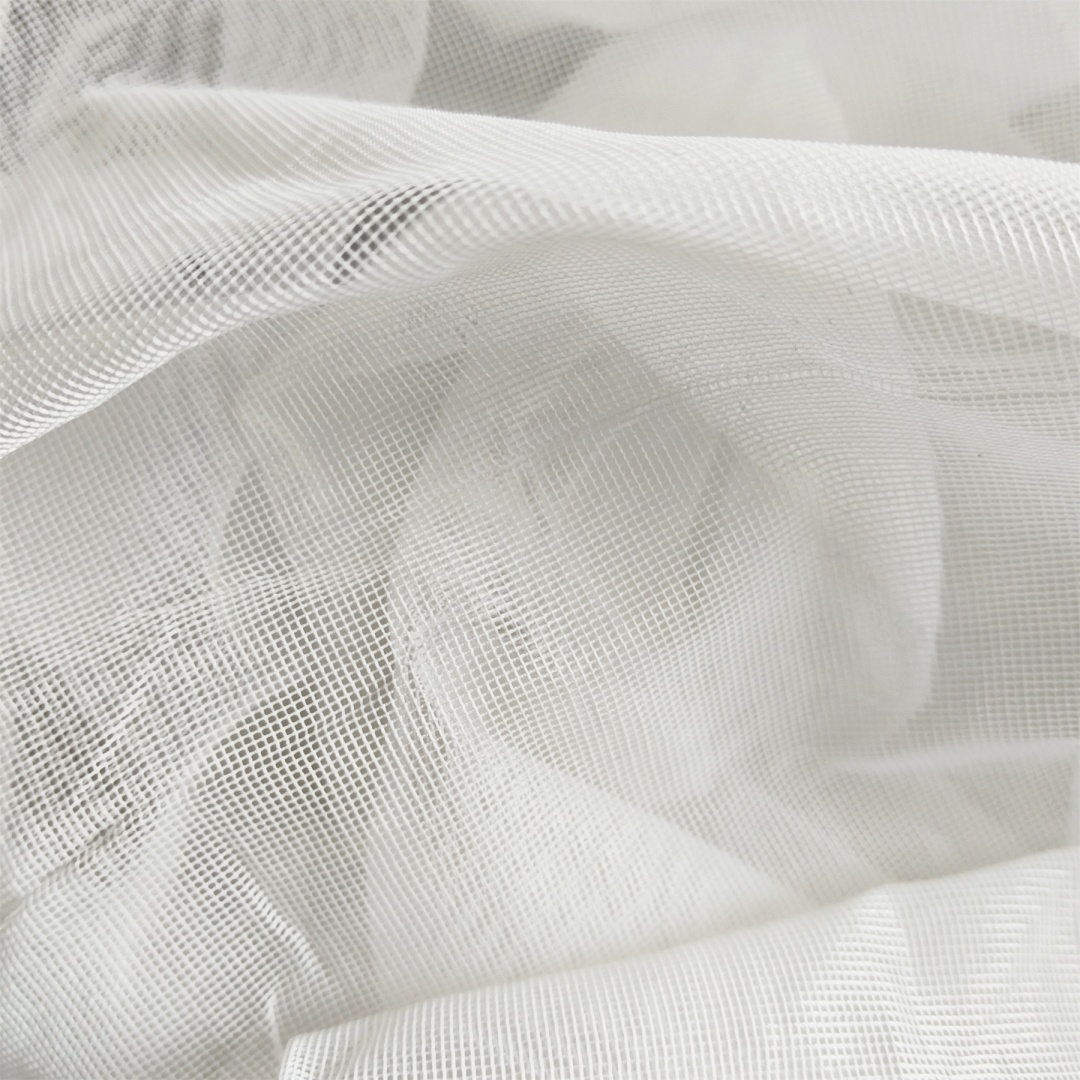
Matching the fabric specification to the exact use case, spatial constraints, and lighting conditions determines the viability of the installation. A material that performs flawlessly in a dark theater will fail spectacularly on a brightly lit trade show floor. You must evaluate the physical environment before specifying the mesh.
Controlled lighting environments like theaters, auditoriums, and corporate keynote stages demand specific material traits. When deploying indoor holographic projection screen fabric, the focus is on achieving deep black levels and seamless integration with existing stage mechanics. The material must be lightweight enough to fly in and out rapidly using automated rigging systems or motor hoists without snagging, billowing, or losing its tensioned shape. Engineers usually opt for black or dark grey meshes in these environments to maximize the invisibility of the screen against dark stage drapes.
Trade show floors present the harshest possible conditions for holographic illusions due to high, uncontrollable ambient light and severely limited footprint dimensions. A 3D projection scrim for exhibitions must maximize light retention to compete with overhead venue lighting. Ultra-short-throw (UST) projectors are often necessary due to tight booth space constraints. Managing the projector beam path is a major logistical challenge. Steep projection angles ensure the beam terminates safely into the carpeted floor or ceiling baffles, preventing it from blinding attendees walking behind the display.
Exhibition scrims are increasingly paired with LiDAR or IR sensor arrays. This integration transforms a passive video projection into an interactive digital display. During product launches, attendees can use hand gestures to rotate, scale, or manipulate floating 3D CAD models, requiring the fabric to remain perfectly stable while users interact near the projection plane.
Touring concerts, arena shows, and large-scale music festivals require ruggedized optical solutions. When you specify holographic projection fabric for live events, it must withstand constant packing, heavy rigging, and rapid striking. Evaluate the material for extreme durability, resistance to atmospheric humidity, and the ease of folding for transport in flight cases without developing permanent creases. Rapid deployment capabilities, such as reinforced quick-clip webbing or heavy-duty velcro borders, are essential for crews working under tight production schedules.
AV teams must accept and actively manage several conceptual trade-offs when designing a holographic system. Ignoring these physical limitations will result in a compromised visual experience. You cannot cheat the physics of light.
Ambient light hitting the front of the scrim is the single fastest way to destroy the holographic illusion. Any rogue light from stage washes, exit signs, or audience phones will illuminate the physical threads, instantly revealing the flat screen to the audience and collapsing the 3D depth.
Mitigate this risk by executing precise stage lighting design. Use steep angles for overhead stage lighting, deploy barn doors on all fixtures to cut spill, and strictly avoid any front wash lighting on the scrim plane. Keep the physical area immediately behind the screen dimly lit to maintain the high contrast necessary for the projection to pop against the background.
Because the fabric is highly transparent by design, audiences can often see the projector lens directly through the screen if placed improperly. This creates a glaring, bright hot spot that shatters the immersion and causes eye strain.
Solve this through strict geometric planning and lens calculation. Utilize steep projection angles and off-axis lenses to move the projector body entirely out of the audience's direct line of sight. For rear-projection setups, ensure the beam path terminates into a black drape, light trap, or dark void rather than hitting a reflective surface or a bright wall behind the audience seating area.
Disconnects between the physical fabric setup and the media server can lead to latency, alignment issues, or improper scaling of the digital assets. If the digital file does not match the physical dimensions of the tensioned mesh, the illusion fails.
Modern workflows integrate cloud-based holographic platforms and plug-and-play media servers. These advanced systems allow remote content distribution and real-time geometric mapping directly onto the tensioned fabric. By using grid calibration, operators can warp the image to ensure the digital asset aligns perfectly with physical stage props, maintaining the spatial logic of the illusion even if the truss is slightly off-level.
Procuring materials for enterprise-grade or high-stakes live events requires rigorous supplier vetting to avoid catastrophic on-site failures. You need a partner who understands the mechanical demands of live rigging.
A credible custom holographic screen fabric supplier provides more than just raw yardage cut from a roll. Look for vendors who offer custom finishing, including reinforced heavy-duty webbing, specific grommet spacing tailored to your truss dimensions, and integrated rigging hardware.
Always request A4 or 1-meter sample swatches during the pre-production phase. Test these prototypes with the actual projector model, lens, and lighting rig you plan to use before committing to a large-scale purchase. This physical testing is the only definitive way to verify how the specific dye, coating, and weave density will react to your venue's unique atmospheric and lighting conditions.
Standard off-the-shelf roll widths are often limited to 1.52 meters. For large stage designs, seaming these narrow rolls together creates visible vertical lines that catch light and break the 3D illusion. A capable polyester projection screen fabric manufacturer operates wide-loom machinery capable of producing custom seamless widths up to 8 or 10 meters wide.
Quality assurance is paramount during the extrusion and weaving process. Manufacturers must guarantee zero weaving defects. A single snag, dropped thread, or inconsistent dye patch will catch light aggressively and ruin the visual effect for the entire audience. Verify exact lead times for custom manufacturing and insist on secure, crease-free shipping tubes to prevent transit damage or folding creases that cannot be tensioned out on site.
Inspect the truss frame to ensure it is perfectly square and level before attaching the material.
Secure the top edge of the mesh using high-tension bungee ties through the reinforced grommets, starting from the center and working outward.
Insert a heavy steel pipe into the bottom pocket to provide uniform downward gravitational tension.
Anchor the side grommets to the vertical truss legs, applying equal lateral force to eliminate diagonal wrinkles.
Verify the focal plane is completely flat by shining a test grid pattern from the projector and checking for geometric distortion.
To execute a flawless holographic deployment, you must treat the projection fabric as a precision optical instrument rather than a standard stage drape.
Calculate your exact throw distances, lens shift requirements, and projector placement geometry before ordering materials.
Request technical spec sheets and physical sample swatches from shortlisted manufacturers to conduct rigorous on-site testing.
Audit your venue's lighting plot to ensure all ambient light and stage fixtures can be directed safely away from the projection plane.
Verify custom finishing options to match your specific truss dimensions and preferred rigging hardware.
A: The optimal transparency level typically falls between 75% and 85%. This range perfectly balances the physical invisibility of the screen with sufficient thread density to capture projected light. Going higher than 85% usually results in a severe loss of image brightness, while dropping below 75% makes the physical mesh too visible to the audience.
A: Standard office projectors lack the necessary power. You need high-lumen laser projectors, typically starting at 10,000+ lumens. Because the mesh is highly transparent, a significant percentage of light passes straight through it, requiring massive brightness to register a visible image on the threads.
A: Maintenance should be limited to gentle dry brushing with a soft-bristle tool or using compressed air to remove surface dust. Strictly avoid liquid cleaners, solvents, or damp cloths, as these will degrade the specialized optical coatings and ruin the fabric's reflectivity.
A: Holographic glass uses the traditional Pepper's Ghost technique, requiring heavy, rigid panels angled at 45 degrees to bounce light. Projection fabric is a lightweight, tensioned vertical scrim that allows for direct front or rear projection, saving massive amounts of stage space and rigging time.
A: The fabric must be stretched with firm, even four-way tension across a rigid frame or truss. This eliminates all wrinkles, creases, and sagging, ensuring a perfectly flat focal plane that prevents the projected image from distorting or waving during the performance.
A: Yes. Black or grey mesh absorbs ambient light, providing superior contrast and making the screen nearly invisible in dark rooms. Silver or white mesh maximizes image brightness and color saturation but is much easier for the audience to see if ambient light hits it.
A: Yes. By pairing the tensioned fabric with external IR cameras, LiDAR sensors, or motion tracking systems, users can interact with the floating 3D content using hand gestures. This makes the setup highly effective for product launches and interactive exhibitions.


