Jumbo Roll Scrim Backing Fabric

- All
- Product Name
- Product Keyword
- Product Model
- Product Summary
- Product Description
- Multi Field Search
Views: 0 Author: Site Editor Publish Time: 2026-11-02 Origin: Site


The backing fabric serves as the structural foundation in industrial tape manufacturing. It dictates mechanical properties, processing efficiency, and end-user reliability. Tape manufacturers face a persistent challenge on the production floor. They must source a fabric capable of withstanding high-stress coating and calendaring processes. Simultaneously, the material must maintain precise end-user characteristics. These traits include straight hand-tearability, water resistance, and high tensile strength. We present a technical evaluation framework for selecting the optimal polyester base cloth for duct tape. This guide focuses strictly on weave specifications, processing compatibility, and strategic supplier vetting. You will learn how to minimize production downtime and reduce material waste effectively on your coating lines.
Weave Geometry Dictates Performance: The warp and weft configuration of the polyester scrim directly controls the balance between longitudinal strength and lateral tearability.
Processing Compatibility is Non-Negotiable: Base cloth must possess the dimensional and thermal stability required to survive high-temperature calendaring without shrinking or distorting.
Seamless Rolls Drive Efficiency: Utilizing seamless polyester woven scrim for tape rolls drastically reduces machine downtime and splicing waste during continuous manufacturing.
Supplier Capabilities Matter: Partnering with a specialized custom polyester tape backing fabric manufacturer ensures batch-to-batch consistency, contamination-free rolls, and alignment with specific adhesive formulations.
Duct tape relies entirely on a three-part composite structure to function. The base cloth acts as the primary structural matrix. It binds the waterproof polyethylene (PE) film to the pressure-sensitive adhesive layer. Without a robust matrix, the tape fails under mechanical stress. You must select an industrial duct tape base cloth that integrates seamlessly with both the plastic and the adhesive. The fabric mesh absorbs the physical loads applied during application. It prevents the adhesive layer from shearing away from the plastic backing.
When this composite structure breaks down, you experience specific failure modes on the job site. Understanding these failures helps you specify the correct fabric.
Adhesive Transfer: The adhesive separates from the cloth and remains on the substrate when the tape is removed. This happens when the cloth lacks the proper surface energy to hold the adhesive.
Film Delamination: The PE film peels away from the cloth matrix. This occurs when the mesh is too tight, preventing the extruded plastic from locking around the yarns.
Tensile Snap: The tape breaks under load. This indicates the warp yarns lack the required denier or tenacity for the application.
You must constantly balance tensile strength against hand-tearability. This mechanical trade-off defines high-quality industrial tape. Polyester outperforms traditional cotton significantly in this arena. It offers a vastly superior strength-to-weight ratio. It resists rot naturally and provides inherent moisture resistance. Cotton absorbs ambient humidity, which degrades adhesive performance over time. Polyester remains dimensionally stable regardless of environmental moisture.
Performance Metric | Polyester Base Cloth | Traditional Cotton Cloth |
|---|---|---|
Moisture Resistance | Excellent (Hydrophobic) | Poor (Absorbs water) |
Strength-to-Weight Ratio | High | Low |
Rot and Mildew Resistance | Complete resistance | Highly susceptible |
Dimensional Stability | High (when heat-set) | Variable based on humidity |
Specific yarn configurations ensure a clean, straight tear. Engineers manipulate the warp and weft tension during weaving. They achieve easy lateral tearing without compromising longitudinal load-bearing capacity. The weft yarns must snap cleanly under manual shear force. If you use a high-tenacity polyester yarn for the weft, the user will stretch the tape before it breaks, resulting in a curled, useless edge. The warp yarns must resist elongation under heavy suspension loads.
Dimensional stability during manufacturing remains critical. Extrusion and lamination exert immense physical forces on the fabric. The web tension pulls the fabric tightly across multiple steel rollers. You must define strict acceptable tolerances for elongation and shrinkage. Excessive elongation narrows the fabric width during processing. Strict tension control prevents the mesh from puncturing the laminated plastic film. If the yarns distort, they create pinholes in the PE layer. Pinholes destroy the waterproof barrier immediately.
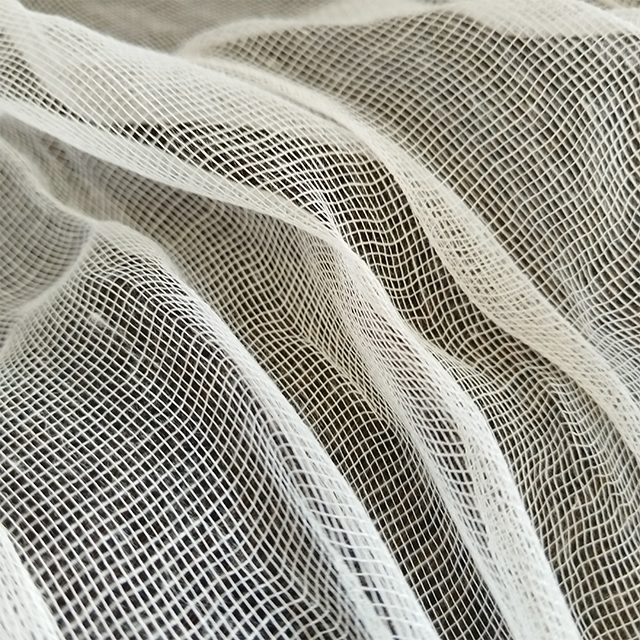
Mesh construction directly dictates overall tape performance. Manufacturers measure this using threads per inch. Common configurations include 18x14, 20x20, or 27x27 weaves. A higher thread count increases the surface area for adhesive bonding. It also increases the overall tensile strength of the tape. Lower thread counts reduce material weight and improve flexibility.
Denier measures the actual thickness of the individual yarns. It directly influences the final tape profile. High-denier yarns (like 500D) create a thicker, more rigid tape used for heavy-duty sandblasting or HVAC applications. Lower denier (like 150D) yields better flexibility. It allows the tape to conform easily to highly uneven surfaces. You must match the denier to the intended application environment.
Weave density controls adhesive penetration during the coating process. A tight weave prevents adequate mechanical locking. The adhesive sits on top of the fabric and shears off easily. A loose weave causes severe adhesive bleed-through. The adhesive pushes entirely through the mesh. This compromises the waterproof barrier and fouls the manufacturing rollers, leading to hours of machine cleanup.
Contamination control remains absolutely non-negotiable in tape manufacturing. The polyester greige base cloth for duct tape must arrive entirely free of weaving oils. Dust, residual sizing agents, and moisture severely degrade adhesive anchorage. Even microscopic oil residues create dead zones where adhesive cannot bond. These dead zones lead to catastrophic delamination in the field.
Consider the extrusion process. When the PE film is extruded, it drops from a flat die at temperatures exceeding 600°F. It meets the polyester scrim at the nip roll. If the scrim contains trapped moisture, that 600°F plastic turns the moisture into steam instantly. The steam creates microscopic bubbles between the film and the cloth. These bubbles guarantee film delamination.
Mechanical or chemical surface treatments enhance bonding significantly. Calendaring flattens the yarns to increase contact area. Singeing burns off microscopic protruding fibers. Chemical primers alter the surface energy of the polyester. Untreated polyester typically sits around 43 dynes/cm. Water-based acrylic adhesives often require surface energies above 50 dynes/cm to wet out properly. You must match the treatment to your chosen hot melt, natural rubber, or synthetic acrylic adhesives.
Implement strict testing protocols to verify anchorage strength. Use the ASTM D3330 standard for peel adhesion testing. This verifies that the adhesive stays bonded to the fabric under severe stress. You must ensure the adhesive fails cohesively before it fails adhesively. The bond to the cloth must remain stronger than the internal strength of the adhesive itself.
The calendaring process presses the adhesive firmly into the cloth matrix. Heavy steel rollers and rubber backing rolls apply massive pressure and high heat simultaneously. This promotes full contact and deep mechanical locking. The process demands exceptional thermal resistance from the base fabric. Standard polyester shrinks violently when exposed to these temperatures.
Heat-set polyester prevents fabric shrinkage entirely. The manufacturer pre-shrinks the fabric using high-temperature stenter frames before shipping. This locks the molecular structure of the yarns. The polyester duct tape scrim for calendaring withstands high-temperature adhesive melts without distorting. It survives heat-bonding lamination processes flawlessly. Using non-heat-set fabric causes the tape to neck down, curl, and warp immediately upon cooling.
Stiffness and uniformity affect web tracking heavily. The fabric must feed smoothly through the coating line at speeds often exceeding 300 feet per minute. Uneven stiffness causes the fabric to drift laterally across the rollers. This requires constant operator intervention and slows down line speeds.
Poor tension control causes severe manufacturing defects. You will see curling, wrinkling, or telescoping rolls at the rewinder. Precise base cloth selection mitigates these issues entirely. A uniform scrim maintains even tension across the entire web width. It keeps the coating line running smoothly and maximizes daily output.
Spliced base cloth rolls cost manufacturers significant money. A standard loom weaves fabric in shorter lengths. If the weaver sews these together to make a jumbo roll, you end up with multiple splices. Every time an overlap splice hits the coating head, the operator has to lift the head to let the thick seam pass. That leaves a long section of uncoated tape.
This generates significant material waste during the coating process. The spliced section cannot be sold and must be discarded. Furthermore, splices can jam the calendaring nip, causing web breaks. A web break requires re-threading the entire machine, resulting in hours of lost production time.
Specifying seamless polyester woven scrim for tape rolls provides distinct manufacturing advantages. Seamless weaving uses specialized continuous take-up systems to weave massive lengths without a single stop. They excel in high-speed, continuous coating operations. Seamless rolls eliminate splice-related machine stops entirely. They improve overall equipment effectiveness metrics dramatically. They reduce scrap rates and increase the yield of sellable tape.
Bulk roll specifications dictate handling efficiency on the factory floor. You must define strict length and width tolerances. Jumbo rolls can measure 60 inches wide and hold 10,000 meters of fabric. Core crush resistance prevents the roll from collapsing under its own massive weight. Collapsed cores render the entire roll unusable on automated unwinding stands.
Uniform winding tension prevents edge damage during transit. It ensures consistent unwinding during the lamination process. Loose winding causes the fabric to sag on the machine, creating wrinkles in the final tape. Over-tight winding stretches the fabric prematurely, leading to shrinkage later. Proper winding tension guarantees a flat, stable web entering the calendaring nip.
Off-the-shelf scrims work adequately for general-purpose consumer tapes. However, demanding industrial applications require custom-engineered fabrics. HVAC tapes need specific thermal degradation resistance to survive decades in hot attics. Automotive tapes require extreme conformability for wire harnessing in tight engine compartments. Nuclear-grade tapes demand absolute purity and zero outgassing.
Co-develop specifications directly with a custom polyester tape backing fabric manufacturer. Match the fabric precisely to your unique performance characteristics. Adjust the warp and weft tension to hit exact tearability targets. Modify the chemical sizing to match your proprietary adhesive formulation.
Quality assurance requires rigorous, verifiable documentation. You cannot rely on visual inspections alone. Implement a strict audit process for any new weaving facility.
Request Certificates of Analysis (COA): Demand a COA for every single shipment. This verifies tensile strength, weave uniformity, and surface cleanliness before the material enters your facility.
Verify ISO Certifications: Demand current ISO certifications from the manufacturing facility to guarantee batch-to-batch consistency.
Inspect Loom Technology: Determine if they use air jet, water jet, or rapier looms. Water jet looms require exceptional drying processes to avoid moisture contamination in the final roll.
Assess supply chain scalability before signing long-term contracts. Check their monthly weaving capacity and standard lead times. Verify their Minimum Order Quantities align with your production schedules. Ensure they can handle sudden spikes in your material demand. You need a bulk polyester scrim backing supplier capable of uninterrupted production.
Evaluate overall operational efficiency carefully. Factor in historical defect rates and material rejection costs. Calculate the value of increased machine uptime from seamless rolls. Analyze shipping logistics and warehouse holding costs. A cheaper fabric that causes machine jams costs more ultimately.
Inadequate adhesive penetration causes immediate delamination. Surface contamination separates the cloth from the PE film under stress. If the adhesive cannot grip the yarn fibers, the tape fails. Conduct pilot runs to mitigate these risks effectively. Test adhesion on scrap material before running a full master roll. Verify the compatibility of fabric porosity and surface energy. Match them precisely with the specific viscosity of your adhesive formulation. Adjust the calendaring pressure if penetration remains insufficient.
Over-specifying tensile strength ruins hand-tearability completely. If the weft yarns are too thick, workers cannot tear the tape manually. They must use knives, which slows down application speeds in the field. Failing to account for thermal shrinkage causes severe warping during hot melt application.
Establish a rigorous prototyping phase for new tape designs. Test the composite tape against actual end-user performance characteristics. Do this long before approving full-scale manufacturing. Give prototypes to field workers for real-world usability testing. Adjust the base cloth specifications based on their direct feedback.
Relying on a single supplier causes catastrophic stockouts eventually. Global shipping delays or localized factory shutdowns halt your production lines. You cannot manufacture tape without the base cloth matrix. Establish secondary approved suppliers immediately. Maintain a rolling safety stock of validated greige cloth in your warehouse. Audit your secondary suppliers annually to ensure their quality remains acceptable. Split your purchasing volume to keep both supply chains active and responsive.
Coating Defect | Root Cause | Mitigation Strategy |
|---|---|---|
Adhesive Bleed-Through | Weave density too loose for adhesive viscosity | Specify a tighter mesh count or increase adhesive viscosity. |
Web Warping/Curling | Thermal shrinkage in the calendaring nip | Mandate heat-set polyester from the supplier. |
Film Pinholes | Uneven yarn tension puncturing the PE film | Improve web tension control; verify yarn uniformity. |
Coating Head Jams | Thick overlap splices passing through the nip | Switch to seamless woven scrim rolls exclusively. |
Poor Anchorage | Residual weaving oils or low surface energy | Require COAs for cleanliness; implement chemical primers. |
Selecting the right fabric requires balancing mechanical performance with manufacturing efficiency. You must achieve high tensile strength, straight tearability, and water resistance simultaneously. You must also ensure calendaring stability and utilize seamless rolls to maximize yield. Prioritize suppliers offering verifiable quality control data and custom engineering support. A properly specified base cloth eliminates production bottlenecks and guarantees end-user satisfaction.
Request detailed technical data sheets from prospective fabric suppliers immediately to verify denier and mesh counts.
Secure sample rolls to conduct lab-scale peel adhesion and tensile strength testing against your current adhesive formulations.
Schedule a pilot coating run to verify thermal stability, web tracking, and adhesive penetration under actual machine conditions.
Establish a secondary supplier qualification process to protect your production schedule from unexpected supply chain shocks.
A: The optimal choice is a heat-set, precisely woven polyester scrim. It balances longitudinal tensile strength with clean lateral hand-tearability. You need a fabric with high surface energy and zero contamination to guarantee strong adhesive anchorage during high-speed coating operations.
A: Polyester delivers superior moisture resistance and a much higher strength-to-weight ratio than cotton. It completely resists rot and environmental degradation. Polyester maintains strict dimensional stability in humid conditions. This prevents the severe adhesive degradation and delamination commonly seen with moisture-absorbing cotton backings.
A: Weave density controls the exact rate of adhesive flow-through. A correctly specified mesh size ensures deep mechanical locking without allowing excessive adhesive bleed-through. It supports the polyethylene film under heavy nip pressure, preventing the yarns from puncturing the plastic and creating waterproof-destroying pinholes.
A: Seamless rolls completely eliminate machine stops caused by passing splices through the coating head. They drastically lower material waste from splice rejections. Running seamless master rolls improves continuous coating efficiency, increases daily yield, and reduces manual operator intervention on the production line.
A: Execute standard laboratory tests including ASTM D3330 for peel adhesion. Perform rolling ball tack tests and conduct accelerated aging in environmental chambers. These protocols verify that the adhesive fails cohesively before it fails adhesively, ensuring it does not delaminate from the scrim under field stress.
A: Focus on verifiable ISO certifications and stringent quality control documentation like Certificates of Analysis. Ensure they have the physical loom capacity to provide seamless rolls and custom weave configurations. They must demonstrate consistent batch-to-batch quality and reliable supply chain scalability for bulk orders.
A: Yes, it is highly compatible with both adhesive systems. However, the fabric must possess the correct surface energy and absolute cleanliness. It also requires specific thermal stability and heat-setting to withstand the vastly different application temperatures required by hot melt versus natural rubber formulations.


