Jumbo Roll Scrim Backing Fabric

- All
- Product Name
- Product Keyword
- Product Model
- Product Summary
- Product Description
- Multi Field Search
Views: 0 Author: Site Editor Publish Time: 2026-11-03 Origin: Site


Event production and exhibition design rely heavily on the physical surface receiving the projected light. You can deploy advanced laser projectors and render flawless content, but if the projection surface fails, the visual illusion collapses. Utilizing standard 2D projection materials for 3D applications results in polarization loss, severe ghosting, poor contrast, and visible hot spots. These artifacts break audience immersion and waste expensive projector investments.
Selecting the correct 3D projection screen fabric requires a strict technical evaluation of gain, surface grain, polarization retention, ambient light conditions, and material tensioning. This guide breaks down the criteria for shortlisting the exact fabric engineered for specific stage, trade show, and installation environments.
Polarization is Non-Negotiable: Passive 3D projection requires specialized silver or highly engineered fabric to maintain light polarization; standard matte white screens will destroy the 3D effect.
Match Material to Environment: High ambient light environments demand grey or ALR (Ambient Light Rejecting) fabrics with anti-glare properties, while holographic effects require specific mesh transparency.
Tension and Grain Dictate Fidelity: Even the highest-grade fabric will fail without proper tensioning and the right surface grain; wrinkles and heavy textures distort 3D geometry and pixel clarity.
Quality Assurance is Critical: Rigorous projection screen fabric quality inspection prevents costly on-site failures related to micro-tears, uneven coating, or inconsistent gain.
Defining the technical baseline required for a screen to successfully render 3D content without visual artifacts is the first step in system design. A projection surface must actively manage light rather than simply catch it. When dealing with stereoscopic images, the fabric acts as an optical filter. If this filter fails, the viewer experiences eye strain, blurred images, and a complete loss of depth perception. We evaluate these surfaces based on strict optical performance metrics.
Passive 3D systems rely on either circular or linear polarization to separate the left-eye and right-eye images. The projector sends two overlapping images, each polarized in a different direction. The screen must reflect this light back to the audience without altering its polarization state. Standard matte white screens scatter light randomly. This scattering destroys the polarization, meaning both eyes see both images simultaneously.
To maintain the polarization state, the fabric requires a specialized metallic or highly engineered optical coating. Silver screens are the traditional standard for this application. The critical metric here is the crosstalk threshold. Crosstalk, commonly known as ghosting, occurs when the left eye perceives a fraction of the right-eye image. A high-quality surface coating minimizes this bleed. Industry standards dictate that crosstalk should remain below 1% for optimal viewing. If the coating is uneven or lacks the correct reflective properties, ghosting exceeds acceptable limits, ruining the stereoscopic effect. Engineers measure this using polarization extinction ratios, ensuring the fabric maintains the exact light orientation emitted by the projector lens.
A good projector screen must have the right grain for high-resolution 3D mapping. Modern laser projectors output native 4K and even 8K resolutions. At these pixel densities, the physical texture of the screen becomes a limiting factor. If the surface grain is larger than the projected pixel size, the image loses sharpness. The physical bumps and woven threads cast microscopic shadows across the image plane.
Heavy textures or micro-abrasions on the fabric surface distort pixels. This physical distortion disrupts the precise geometry required for 3D mapping. When mapping complex architectural shapes or intricate stage sets, pixel-perfect alignment is mandatory. Surface imperfections introduce visual noise, making sharp edges appear soft and reducing the overall impact of the 3D illusion. Smooth, ultra-fine grain surfaces ensure that the microscopic details of the projection remain intact upon reflection. For close-proximity viewing at trade shows, a textureless PVC or tightly woven synthetic blend is mandatory to prevent the screen door effect where the material's weave becomes visible to the naked eye.
Screen gain measures the reflectivity of a surface compared to a standard matte white reference board. In 3D projection, gain is a critical variable because 3D glasses inherently reduce perceived brightness by up to 50%. You must compensate for this massive light loss. High-gain screens reflect more light back toward the center of the viewing area, restoring the perceived brightness of the image. A gain of 1.8 to 2.4 is common for passive 3D applications.
However, this introduces a strict trade-off. High-gain screens narrow the optimal viewing angle, known as the half-gain angle. Viewers seated off-center will experience a significantly dimmer image. You must balance the need for brightness with the spatial layout of your audience. Furthermore, maintaining depth perception requires deep black levels and high contrast. The fabric must support vibrant color fidelity while preventing light scatter that washes out darker areas of the image. A screen that pushes gain too high often sacrifices contrast, flattening the 3D effect. AV technicians must calculate the exact seating footprint and match it to the fabric's viewing cone specifications.
Trade halls and stage venues are rarely pitch-black. Ambient light from stage fixtures, exit signs, and overhead rigging washes out 3D depth cues. When ambient light hits a standard screen, it reflects alongside the projected image, destroying contrast and black levels. ALR surfaces are structurally engineered to solve this problem. They act as optical filters, rejecting light that does not originate from the projector's specific angle.
ALR fabrics use either angular reflective or retro-reflective microstructures. Angular reflective screens bounce off-axis ambient light away from the audience, while retro-reflective screens bounce light directly back toward the source. Enhanced anti-glare (AG) properties selectively diffuse the projector's light while maintaining deep black levels. This engineering allows 3D visuals to punch through heavy ambient lighting, preserving the illusion of depth without requiring an exponential increase in projector lumen output. Implementing ALR technology requires precise geometry; the projector lens, screen surface, and audience eye-line must align perfectly to maximize the rejection of overhead venue lighting.
Comparing the physical materials available for different 3D projection applications ensures you specify the right tool for the environment. No single fabric excels in every scenario. The choice depends entirely on the projection technology, lighting conditions, and desired visual effect. We categorize these materials based on their optical behavior and structural integrity.
Active 3D systems use battery-powered shutter glasses that sync with the projector, alternately blocking the left and right eyes. Because active 3D does not rely on polarization, you do not need a silver screen. In these scenarios, a white polyester 3D projection screen cloth provides exceptional performance. It is ideal for controlled lighting environments and high-brightness projection mapping.
The technical benefits include excellent color fidelity, wide viewing angles, and high durability. Polyester blends resist stretching and tearing, making them perfect for rental and staging applications that require repeated setup and teardown. The material can often be folded for transport without sustaining permanent creases, provided it is tensioned correctly upon installation. However, white polyester has limitations. It performs poorly in high ambient light and is completely unsuitable for passive polarized 3D unless treated with specialized silver coatings. It diffuses light evenly, which is excellent for wide audiences but offers no defense against overhead stage wash.
Live concerts and theatrical stages present a unique challenge: heavy ambient stage lighting. Moving head profiles, wash lights, and LED walls generate massive amounts of light spill. A white screen will catch this spill, turning blacks into muddy grays. To combat this, AV integrators rely on grey projection screen fabric for stage events.
The grey substrate inherently deepens black levels and enhances perceived contrast. It absorbs a portion of the ambient light, mitigating the impact of stage fixtures. This allows the projection to maintain a punchy, high-contrast image even when the stage is active. The primary limitation is negative gain. Because the fabric absorbs light, it requires higher lumen output from the projectors to achieve the same perceived brightness as a white screen. You must calculate the projector's output carefully to overcome the grey fabric's light absorption. Typically, upgrading from a 10,000-lumen to a 20,000-lumen laser projector is necessary when transitioning from a white to a grey surface in a live event setting.
When the creative brief calls for floating 3D visuals, interactive stage holograms, or modern Pepper's Ghost effects, standard opaque screens will not work. You need a surface that captures light while remaining invisible to the audience. A holographic projection screen mesh is engineered specifically for this dual purpose.
The technical benefit of this mesh is its high transparency combined with high reflectivity. The woven structure catches the projected pixels, creating a solid-looking image, while the gaps in the mesh allow the audience to see physical objects, performers, or LED screens positioned behind the surface. Proper lighting design is crucial here; the area behind the mesh must be lit carefully to maintain the illusion of a floating hologram. Any light hitting the mesh directly from the front or back will reveal the fabric, destroying the effect. The mesh is typically woven from highly reflective silver or metallic threads, ensuring maximum light return from the projector while maintaining a transparent profile against a dark background.
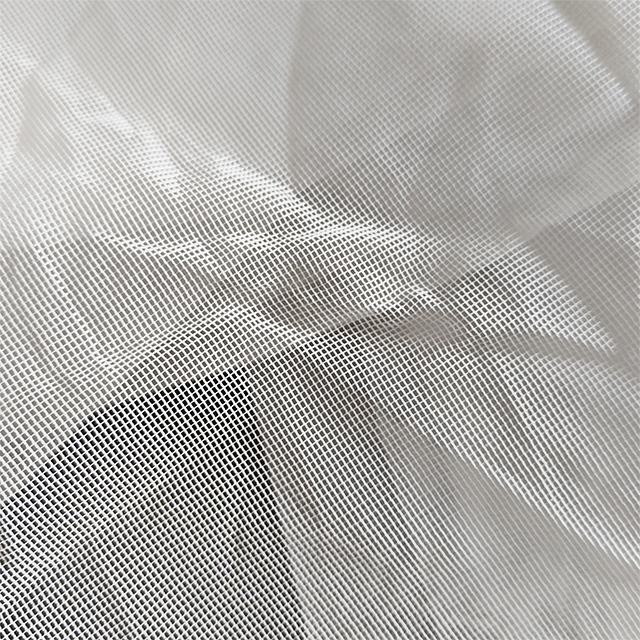
Immersive booth designs often require layered visual effects and lightweight rigging. A projection scrim for trade show exhibitions offers a versatile solution for these environments. Scrims are highly specialized fabrics that change their appearance based on how they are lit. Sharkstooth scrim is the industry standard for this application.
When lit from the front with a projector, the scrim appears solid, displaying the 3D content. When the projector is cut and the area behind the scrim is illuminated, the fabric effectively disappears, revealing whatever is behind it. Additional technical benefits include acoustic transparency, allowing speakers to be placed directly behind the screen without muffling high frequencies. The ultra-lightweight nature of scrim makes it easy to transport and rig on standard exhibition truss structures. It requires minimal tensioning compared to heavy PVC screens, making it a fast and efficient option for temporary trade show booths.
Material Type | Best Use Case | Primary Technical Benefit | Key Limitation |
|---|---|---|---|
White Polyester Cloth | Active 3D, Dark Rooms | Wide viewing angle, high durability | Poor ambient light rejection |
Grey Fabric | Live Concerts, Theatrical Stages | Deep black levels, high contrast | Requires high-lumen projectors |
Holographic Mesh | Floating Holograms, Stage Effects | High transparency and reflectivity | Requires strict background lighting control |
Projection Scrim | Trade Shows, Layered Effects | Acoustic transparency, lightweight rigging | Susceptible to ambient light wash-out |
Specifying materials for large-scale or non-standard architectural applications requires precise engineering. Off-the-shelf screens rarely fit custom stage designs or massive exhibition booths. You must evaluate sizing limitations, seam placement, and tensioning mechanics to ensure a flawless final product. A screen that sags or shows visible seams will instantly break the 3D illusion.
Calculating the optimal screen size is the foundation of custom design. The screen must perfectly complement the projection distance and the audience's viewing area. If the screen is too large for the projector's throw ratio, you lose brightness and pixel density. When ordering custom projection screen fabric for exhibitions, you must determine the maximum seamless width capabilities of the material.
Visible seams in the middle of a 3D projection mapping surface will break the geometric illusion. High-quality manufacturers can weave or micro-weld fabrics to massive widths, avoiding disruptive lines. Next, assess edge finishing options based on your rigging system. Grommets and reinforced webbing work well for truss lacing, while keder edges slide seamlessly into aluminum extrusion frames. Snap buttons offer quick deployment for fast-turnaround events. Finally, always evaluate fire retardant (FR) certifications. Public exhibition spaces strictly enforce fire codes. Materials must carry certifications like NFPA 701 or DIN 4102 B1, and non-certified fabrics will be rejected by venue safety inspectors during load-in.
3D mapping requires absolute surface flatness. Any deviation, wave, or wrinkle causes focal loss and geometry distortion. If the physical surface moves or sags, the projected 3D grid misaligns, ruining the effect. Achieving this flatness requires robust tensioning systems that apply even pressure across the entire fabric plane.
Tab-tensioned motorized systems use a flexible cable running through tabs along the side of the screen, pulling the fabric taut horizontally while the weighted bottom bar provides vertical tension. This is ideal for permanent installations. For live events, fixed-frame lace-and-grommet tensioning is the industry standard. Bungee cords or heavy-duty lacing cord wrap around a rigid truss frame, pulling the fabric evenly in all directions. This method guarantees a perfectly flat, drum-like surface capable of resolving the finest 3D details. When lacing a screen, technicians must follow a specific star-pattern sequence to ensure the tension is distributed evenly and no localized stretching occurs.
Identifying common points of failure during installation allows you to mitigate risks before the audience arrives. Even the best fabric will perform poorly if paired with the wrong lens or if manufacturing defects go unnoticed until load-in. Field technicians must anticipate optical conflicts and verify material integrity long before the projectors are powered on.
Hot spotting is a severe visual artifact where a bright glare appears in the center of the screen, while the edges remain dark. This destroys the uniformity of the 3D image. Hot spots are almost always caused by pairing high-gain fabric with short-throw projectors. The aggressive angle of the short-throw lens hits the highly reflective surface and bounces directly back at the viewer in a concentrated beam, rather than diffusing evenly across the viewing cone.
To ensure uniform luminance, you must match the projector throw distance to the screen gain. As a general rule, high-gain screens require long-throw lenses. The throw ratio should typically exceed 1.5:1 when using fabrics with a gain higher than 1.3. Furthermore, optimal projector placement is critical. Align the projection-axis as close to the audience's line-of-sight as possible. If the projector is rigged too high or too low, the directional reflectivity of the high-gain surface will push the brightest part of the image away from the viewers' eyes. Calculating the exact reflection angle during the CAD design phase prevents hot spotting on site.
Never assume a fabric is flawless straight from the factory. Rigorous projection screen fabric quality inspection is the only way to prevent on-site disasters. Buyers must demand strict quality control parameters from manufacturers before taking delivery. Waiting until load-in to discover a manufacturing defect guarantees a compromised show.
Your inspection checklist should start with coating uniformity. Shine a test pattern across the fabric to check for streaks, roller marks, or uneven gain. Verify surface grain consistency; any localized heavy textures will distort pixels. Conduct elasticity testing to ensure the fabric retains its memory after stretching. If it sags after being tensioned on a frame, it will fail during a multi-day event. Verify opacity for solid screens to ensure light doesn't bleed through the back, and rigorously check seam integrity. A poorly welded seam will split under heavy tension on a truss frame. Documenting these checks with high-resolution photos ensures accountability from the supplier.
The success of any 3D projection relies on matching the physical screen material to the specific optical demands of the environment. There is no universal solution, only the correct engineering choice for your specific venue, lighting conditions, and projection hardware. To ensure a flawless deployment, follow these immediate next steps:
Order A4-sized physical fabric samples to conduct on-site tests with your specific projector models and 3D glasses.
Calculate your exact throw ratio and ambient light levels to determine the required screen gain before finalizing the material order.
Verify all fire retardant (FR) certifications with your venue's safety inspector to ensure compliance prior to load-in.
Specify the exact edge finishing requirements, such as keder or grommets, based on your chosen truss or framing system.
A: 3D fabrics are engineered to retain light polarization for passive 3D systems and feature specialized optical coatings to manage the severe brightness loss inherent to 3D glasses. Standard 2D fabrics diffuse light evenly in all directions, which destroys polarization and causes ghosting in stereoscopic projections.
A: No. White polyester is completely opaque and designed for solid image reproduction. Holographic effects require a highly transparent holographic projection screen mesh or scrim that allows the audience to see physical objects behind the projected image.
A: Ensure the projector is placed at the correct throw distance. Avoid using ultra-short-throw lenses on high-gain screens, as the steep light angle creates concentrated glare. Align the projector's lens axis as close to the audience's line-of-sight as possible for uniform brightness.
A: Micro-abrasions, uneven optical coatings, incorrect surface grain, or poor elasticity can cause severe visual artifacts, geometry distortion, and ghosting. These physical material failures cannot be fixed via software or projector calibration on-site, leading to complete visual failure.
A: The ideal scrim balances high transparency with high reflectivity. It must feature a fine mesh structure to remain invisible at standard viewing distances and carry the necessary fire safety certifications required by public exhibition venues.
A: High-quality manufacturers can weave or micro-weld custom fabrics up to massive widths seamlessly. If a seam is absolutely necessary for an oversized application, it must be precision micro-welded to prevent a visible line from disrupting the 3D mapping.


