Jumbo Roll Scrim Backing Fabric

- All
- Product Name
- Product Keyword
- Product Model
- Product Summary
- Product Description
- Multi Field Search
Views: 0 Author: Site Editor Publish Time: 2026-08-21 Origin: Site


Material failure in industrial laminates and composites often traces back to a single hidden flaw: improper reinforcement selection. When engineers choose the wrong substrate, the end product suffers from delamination, tear propagation, or complete mechanical breakdown. You face a strict engineering challenge. You must balance high tensile strength, dimensional stability, low weight, and flexibility without inflating production costs. polyester woven scrim mesh backing solves this problem directly. It serves as a highly engineered, reliable reinforcement layer designed for demanding environments. This material locks composite layers together and prevents elongation under heavy loads. We will evaluate its technical framework, structural advantages, and suitability against alternative reinforcement materials to help you make precise engineering decisions.
Structural Integrity: Woven polyester scrim provides superior mechanical locking and multidirectional stability compared to non-woven alternatives, preventing tear propagation in high-stress applications.
Application Versatility: Functions as a critical reinforcement layer across aerospace, automotive, marine, and construction sectors, specifically in composites, tapes, and membranes.
Evaluation Criteria: Procurement decisions must weigh yarn denier, mesh configuration, coating compatibility, and thermal resistance against specific project requirements.
Risk Mitigation: Ensuring strict manufacturing tolerances and verifying ISO/ASTM compliance are essential steps to prevent integration failures during lamination or coating processes.
The manufacturing process dictates the final structural integrity of the material. Production begins with continuous polyethylene terephthalate (PET) yarns. Industrial rapier or projectile looms align these yarns with exact precision. Warp yarns run vertically down the length of the fabric. Weft yarns run horizontally across the width. Facilities utilize advanced weft cylinders, warp beams, and trico beams to maintain consistent tension across the entire web. This tension prevents slack, eliminates bowing, and ensures uniform grid squares across rolls that can span several meters in width.
Mechanical interlocking defines this process. The warp and weft yarns weave over and under each other. This creates a physical lock at every intersection. Knitted fabrics rely on looped structures that stretch under load. Chemically bonded laid scrims rely entirely on adhesives to hold the grid together. Woven constructions distribute stress across the entire matrix. When a localized load strikes the fabric, the interlocked yarns share the force. This prevents catastrophic tearing and maintains the composite structure even if the surrounding resin matrix fractures.
Engineers evaluate scrim cloth using specific technical metrics. Yarn denier measures the thickness and weight of the individual polyester threads. Higher denier indicates thicker, stronger yarns capable of handling massive tensile loads. Thread count, measured in ends per inch (EPI) and picks per inch (PPI), determines the density of the grid. Open-mesh configurations balance strength with permeability. A wider mesh allows more resin or adhesive to flow through the gaps, creating a stronger bond between the outer composite layers. A tighter mesh provides higher puncture resistance.
Specialized coatings enhance the baseline properties of the raw polyester. Manufacturers apply PVC, acrylic, or custom polymer treatments to the woven grid using dip-coating or knife-over-roll techniques. These coatings serve two primary functions. First, they lock the woven intersections permanently in place, preventing yarn shifting during secondary processing. Second, the coatings act as adhesion promoters. They change the surface energy of the polyester, allowing specific resins or adhesives to bond directly to the fabric during lamination.
Yarn Denier | Typical EPI x PPI | Primary Coating | Target Application |
|---|---|---|---|
250D - 500D | 9 x 9 to 12 x 12 | Acrylic | Lightweight tapes, flexible packaging |
1000D | 4 x 4 to 9 x 9 | PVC | Roofing membranes, automotive interiors |
1500D - 2000D | 2 x 2 to 4 x 4 | Custom Polymer | Heavy-duty cargo nets, structural pipe wraps |
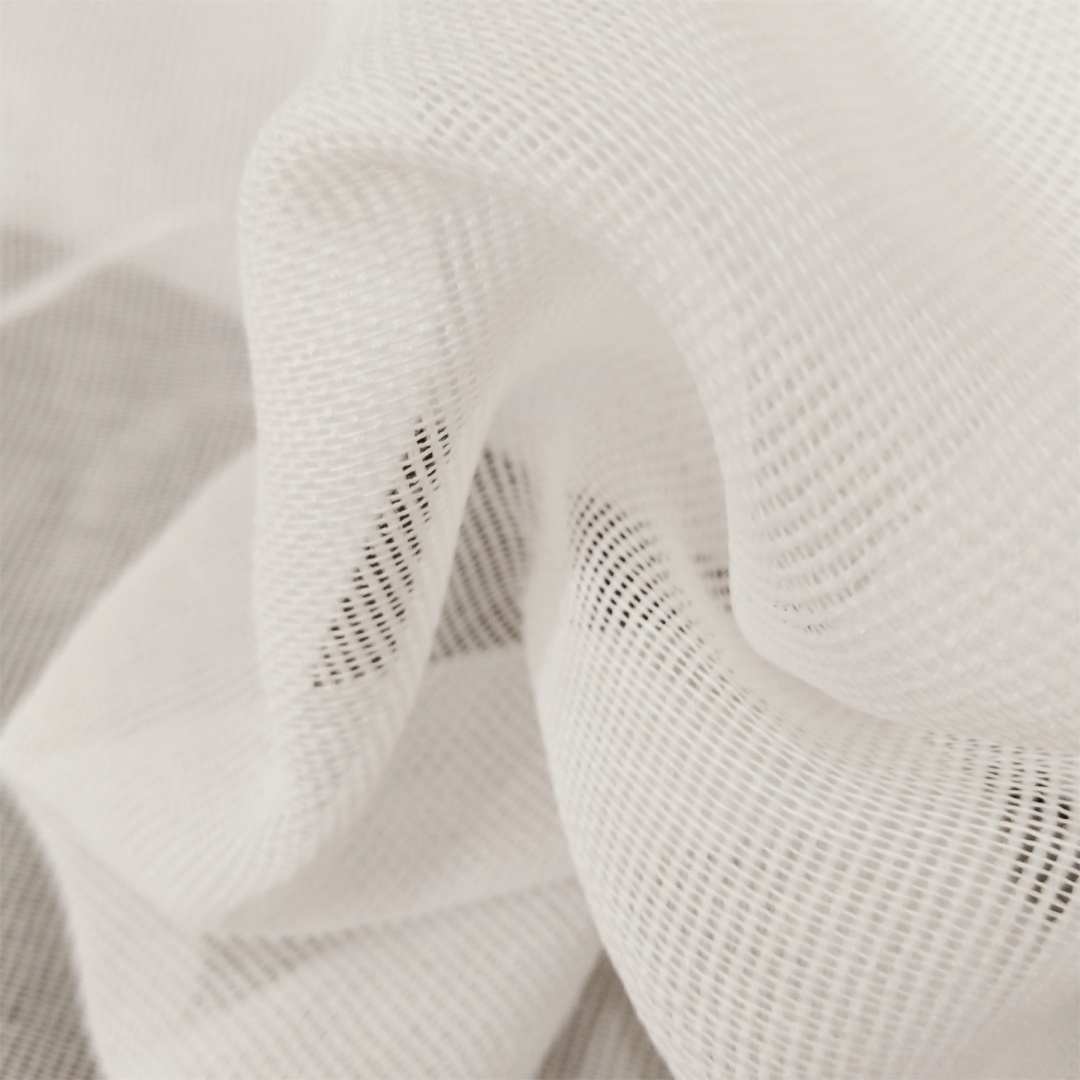
Transportation sectors demand materials that endure extreme dynamic stress. Manufacturers integrate woven polyester into high-liability components. Industrial curtains and cargo nets require massive load-bearing capacities to secure freight during transit. Safety harnesses and seat support substrates demand zero-failure reliability under sudden impact loads. Literature pockets in aircraft interiors need lightweight durability to withstand constant passenger use. Polyester woven scrim meets these strict criteria by providing a flexible, high-strength skeleton.
The weight-to-strength ratio dictates material selection in these fields. Aerospace and automotive designs constantly push for weight reduction to improve fuel efficiency and payload capacity. Polyester provides high tensile strength without adding heavy bulk to the final assembly. Vibration resistance is equally critical. Vehicles experience constant high-frequency vibrations from engines and road surfaces. Rigid materials like fiberglass fracture under continuous vibration. Polyester remains flexible. It absorbs kinetic energy without suffering from fatigue failure.
Construction materials face harsh environmental exposure and continuous physical stress. Roofing membranes utilize woven polyester to resist wind uplift and thermal expansion across large commercial buildings. Wall coverings require dimensional stability to prevent cracking as structures settle over time. Pipe wraps demand a flexible yet strong reinforcement to protect against subterranean pressure, soil shifting, and corrosion. In these applications, woven mesh backing outperforms laid alternatives. The mechanical lock prevents the grid from separating when wrapped around complex pipe geometries or sharp corners.
Industrial adhesive tapes rely heavily on this material. Heavy-duty packaging tapes, structural bonding tapes, and HVAC foil tapes use it as a core matrix. The mesh backing material prevents the tape from elongating under continuous load. When you apply tension to the tape, the woven polyester absorbs the pulling force while the adhesive layer remains intact.
Shear Strength Maintenance: The woven grid prevents the adhesive from creeping under sustained loads.
Tear Resistance: Cross-directional yarns stop lateral tears during automated dispensing.
Conformability: The flexible matrix allows the tape to adhere to irregular surfaces without lifting.
Filtration systems operate under constant hydraulic or pneumatic pressure. Liquid and air filters use polyester scrim as a rigid support substrate. The primary filter media is often fragile and prone to tearing under high velocity. The woven backing provides the necessary structural skeleton. It prevents the filter media from collapsing or blowing out under high flow rates. Dimensional stability is non-negotiable in these systems. The open-mesh configuration allows maximum fluid flow while maintaining structural rigidity. Furthermore, the polyester resists degradation from continuous moisture exposure and varying pH levels found in industrial wastewater.
Load-bearing capacity defines how much weight the fabric can support before failure. Yield stress marks the point where the material deforms permanently and loses its original shape. Elongation limits measure how much the fabric stretches under load before snapping. polyester scrim backing excels in controlling elongation. The woven structure restricts the natural stretch of the polyester yarns, locking the dimensions in place.
This structure distributes mechanical stress efficiently. When a sharp object strikes a laminated composite, the force concentrates on a single point. In non-woven materials, this causes immediate tear propagation. The woven grid stops the tear. The intersecting yarns catch the force and spread it outward across the warp and weft axes. This provides massive puncture and tear resistance without adding unnecessary thickness to the final composite profile.
Performance Metric | Testing Standard | Typical Woven Polyester Value |
|---|---|---|
Breaking Strength (Grab Test) | ASTM D5034 | 150 - 400 lbs/inch |
Tearing Strength (Tongue Tear) | ASTM D2261 | 40 - 120 lbs |
Elongation at Break | ASTM D5034 | 15% - 25% |
Thermal Shrinkage (150°C / 30 min) | ASTM D4974 | < 2.0% |
Industrial environments expose materials to extreme conditions. Polyester offers a realistic operating temperature range from -40°C to 150°C. It maintains its structural integrity within this window. Thermal shrinkage thresholds are low, especially when the fabric is heat-set during manufacturing. This means the fabric will not warp, pucker, or shrink when exposed to hot resins during extrusion coating or lamination.
Chemical resistance profiles are robust. Polyester naturally resists common industrial solvents, mild acids, and alkalis. It does not rot or mildew when exposed to continuous moisture, making it superior to natural fibers. UV degradation can affect raw polyester over long periods of direct sunlight exposure. However, the outer composite layers or specific UV-resistant coatings usually mitigate this risk. This chemical stability ensures a long service life in harsh industrial settings.
A reinforcement layer fails if it delaminates from the primary material. The specific open-weave geometry facilitates optimal strike-through. Strike-through occurs when liquid resin, adhesive, or extruded polymer flows through the gaps in the mesh. The top and bottom layers of the composite bond directly to each other through the grid. The scrim becomes permanently encapsulated within the matrix.
Surface tension plays a major role in adhesion. Raw polyester has a relatively smooth surface with low surface energy. Adhesives struggle to grip it. Manufacturers apply adhesion promoters or specific chemical washes to the fabric. These treatments increase the surface energy. This ensures that PVC, polyurethane, or acrylic adhesives form a destructive bond with the woven mesh. The composite will tear before the layers separate.
Material Type | Construction Method | Flex Fatigue Resistance | Primary Industrial Use |
|---|---|---|---|
Woven Polyester Scrim | Mechanical interlocking (over/under) | Excellent | Heavy-duty composites, dynamic stress environments |
Laid Polyester Scrim | Chemical bonding (adhesive binder) | Moderate | Low-stress laminates, lightweight packaging |
Fiberglass Scrim | Woven or Laid | Poor (brittle under flex) | Static environments, high-heat applications |
Nylon Scrim | Woven | High (but absorbs moisture) | High-stretch requirements, specialized inflatables |
The fundamental difference lies in structural integrity. Woven yarns physically lock together. Laid scrim yarns simply rest on top of each other and rely on a chemical binder to hold the grid. If the binder fails in a laid scrim due to heat, moisture, or chemical exposure, the entire grid falls apart. Woven constructions maintain their grid even if the coating degrades.
You must analyze the trade-offs. Laid scrim is highly cost-effective and lightweight. It works perfectly for low-stress applications like lightweight sailcloth or basic packaging. However, heavy-duty industrial fabrics require superior durability. Woven constructions deliver higher tear resistance and a longer fatigue life. When human safety or structural integrity is on the line, woven mesh is the required standard.
Engineers often debate between polyester and fiberglass. Fiberglass offers exceptional tensile strength and high heat resistance. However, fiberglass fails in dynamic applications. It is brittle. Repeated bending or vibration causes the glass fibers to snap, destroying the reinforcement matrix. Polyester outperforms fiberglass in high-flex environments. It bends repeatedly without losing strength. Polyester also offers superior moisture resistance compared to nylon.
Nylon provides massive tensile strength and elasticity. Yet, nylon absorbs water. This moisture absorption causes the material to swell, lose dimensional stability, and degrade in strength. Polyester remains dimensionally stable even when fully submerged. Polyester also provides better cost-effectiveness for large-scale industrial runs compared to specialized nylon alternatives.
Integrating mesh backing into automated lines carries specific risks. You must screen for common manufacturing defects. Inconsistent yarn tension from the warp or weft beams causes irregular mesh uniformity. Some squares will be tight, others loose. Coating pooling occurs when the chemical binder applies unevenly, creating hard spots on the roll.
These defects destroy automated lamination lines. Uneven tension causes the web to track poorly through the rollers. Wrinkling occurs. A wrinkled scrim creates air pockets inside the composite. This leads to immediate delamination. Strict quality control and tight manufacturing tolerances prevent these costly production failures.
Supplier evaluation requires strict criteria. You must verify lead times for continuous production runs. Industrial projects often require custom widths to match specific extrusion dies or lamination rollers. Ensure your supplier can provide these custom dimensions without massive delays. Minimum Order Quantities (MOQs) also impact procurement. Balance your inventory needs against the supplier's MOQ requirements to maintain lean manufacturing.
Industrial materials must meet strict testing standards. Aerospace applications require FAA burn and toxicity certifications. Automotive interiors demand FMVSS flammability compliance. General industrial fabrics rely on ASTM and ISO testing for tensile strength, tear resistance, and elongation. You must demand technical data sheets and compliance certificates from your supplier. Maintain strict documentation and traceability for all raw material sourcing to protect your liability.
Request detailed Technical Data Sheets (TDS) from suppliers to verify yarn denier and tensile strength metrics against your project specifications.
Order prototype roll samples to conduct in-house peel-adhesion and strike-through testing on your specific lamination equipment.
Initiate supplier capability audits to verify tension control processes, loom maintenance, and coating uniformity standards.
Define your exact operating temperature and chemical exposure limits before finalizing the coating specification with the manufacturer.
A: Woven scrim physically interlocks warp and weft yarns over and under each other, creating a mechanical bond. Laid scrim simply places yarns on top of one another in a grid and relies entirely on a chemical adhesive binder to hold the structure together.
A: It acts as an internal skeleton. The woven grid distributes localized mechanical stress across a wider area. This prevents punctures from turning into catastrophic tears and stops the laminate layers from elongating or separating under continuous heavy loads.
A: The aerospace, automotive, marine, and construction industries heavily specify this material. It is critical for cargo nets, safety harnesses, roofing membranes, heavy-duty pipe wraps, and industrial adhesive tapes where failure is not an option.
A: Yes. Engineers can customize the yarn denier, the thread count, and the weave pattern. These adjustments precisely control the final tensile strength, puncture resistance, and elongation limits of the fabric to match specific load requirements.
A: Polyester offers superior flexibility and flex fatigue resistance. Fiberglass is stronger and handles higher heat, but it is brittle and snaps under repeated bending or vibration. Polyester bends continuously without fracturing, making it ideal for dynamic applications.
A: Common standards include ASTM D5034 for breaking strength and elongation, ASTM D2261 for tearing strength, and ASTM D3786 for bursting strength. These tests verify the mechanical reliability of the scrim before it enters production.
A: Often, yes. Raw polyester has low surface energy. Manufacturers apply specific PVC, acrylic, or custom polymer coatings. These coatings act as adhesion promoters, ensuring resins and adhesives bond destructively to the mesh during lamination.


