Jumbo Roll Scrim Backing Fabric

- All
- Product Name
- Product Keyword
- Product Model
- Product Summary
- Product Description
- Multi Field Search
Views: 0 Author: Site Editor Publish Time: 2026-05-15 Origin: Site


In industrial manufacturing, composite panels, commercial upholstery, and technical tapes endure immense physical stress daily. Their structural integrity often relies on an invisible foundation working silently behind the scenes. Without adequate reinforcement, these primary materials risk catastrophic delamination, rapid sagging, or tearing under dynamic tension. Integrating a specialized reinforcement layer solves these inherent vulnerabilities efficiently. A quality polyester scrim backing serves as this critical "hidden layer." It stabilizes primary substrates rapidly. It also extends the lifecycle of foundational materials without adding significant bulk or unnecessary weight.
This article provides technical buyers and product engineers with an objective, specification-driven framework. We will explore how to evaluate and integrate these reinforcing grids into existing production lines safely. You will learn how to match material metrics directly to your specific structural demands. This guidance helps you secure reliable, compliant manufacturing outcomes.
Optimal Strength-to-Weight: Typically weighing under 50-70 g/m², polyester scrim delivers high tear resistance and dimensional stability with minimal mass.
Material Superiority for Moisture: Compared to Kevlar or nylon, polyester (PET) maintains superior dimensional stability in high-moisture and damp environments.
Versatile Processing: Available in laid, woven, and knitted constructions to match specific resin flows, lamination pressures, and flexibility requirements.
Compliance Enabler: Acts as a foundational carrier for flame retardant (FR) and UV treatments, supporting critical industry standards like CAL TB 117-2013 and NFPA 701.
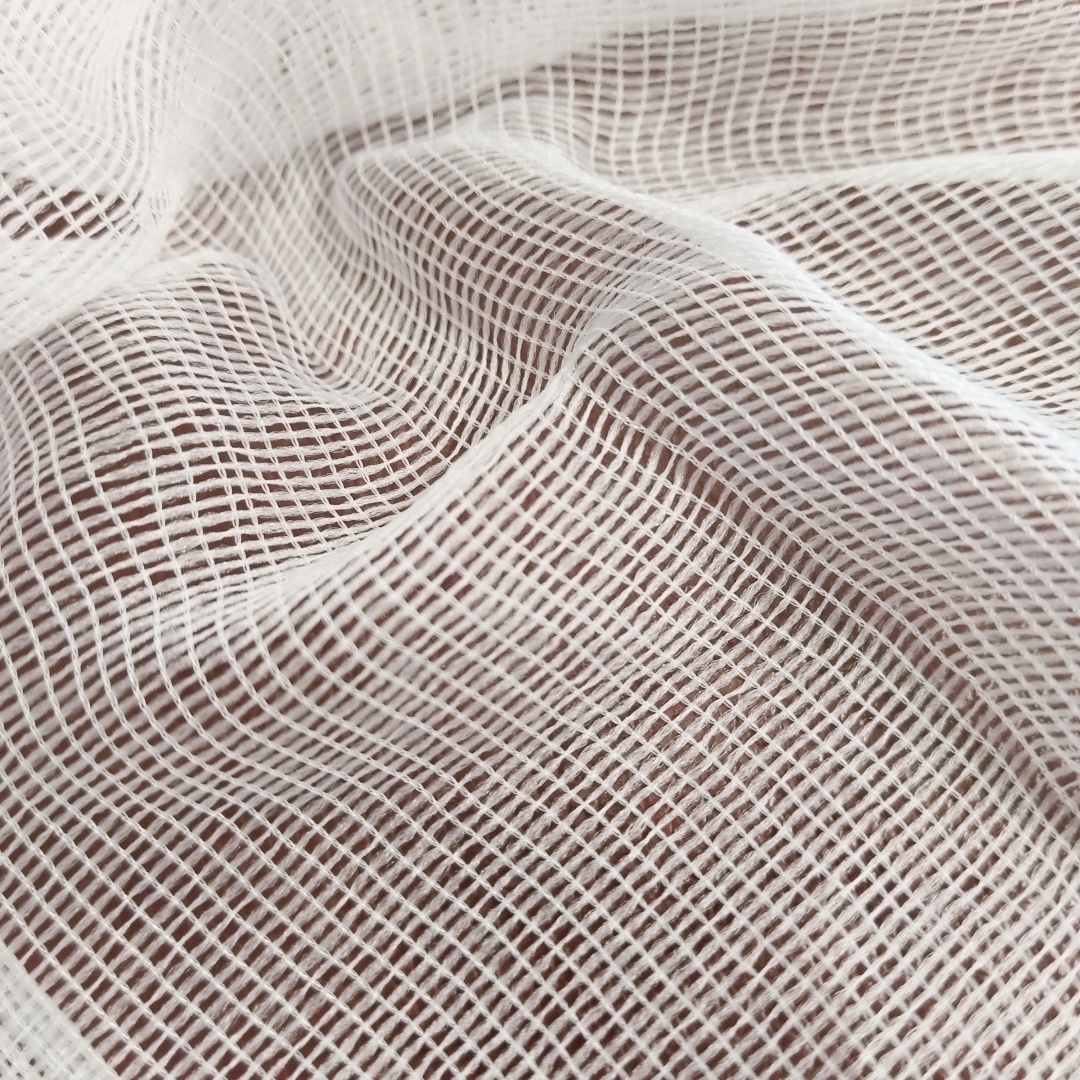
Understanding structural geometry is crucial for material selection. Dense non-woven fabrics use a random, compacted fiber orientation. Tightly woven fabrics pack yarns closely together to restrict airflow. In contrast, a scrim fabric features a distinct open-mesh grid configuration. This engineered open-cell structure balances tensile strength and permeability perfectly.
Manufacturers utilize three primary processes to construct these technical grids. Laid scrims represent the most common high-volume format. During this process, continuous yarn intersections undergo chemical bonding. Facilities often apply polyvinyl acetate to bond these joints securely. This chemical locking enables high-speed production and ensures excellent dimensional stability across the web. Alternatively, a woven scrim cloth utilizes traditional mechanical interlacing. Facilities deploy plain or leno weaves to interlock the fibers. The leno weave physically traps the secondary yarns. This mechanical locking handles significantly higher stress thresholds without yarn slippage. Finally, manufacturers engineer knitted formats for specialized geometries. Knitted variants easily conform to complex, curved surfaces. They deliver vital flexibility without suffering structural deformation.
These mechanics generate a powerful "hidden layer" effect during final assembly. The deliberate open-cell structure promotes deep adhesive penetration. Resins and glues flow freely through the empty mesh squares. The adhesive essentially creates a physical bridge between the top and bottom substrate layers. This mechanical bridging prevents premature lamination failure. It actively stops layer delamination under constant use.
Engineers must evaluate base fibers objectively before integrating them into a product line. Every polymer brings distinct behavioral characteristics. We often compare a standard polyester mesh against alternative technical fibers to highlight these differences clearly.
When comparing polyester (PET) to nylon, clear distinctions emerge. PET offers significantly lower stretch under tension. It resists UV degradation far better than standard nylon. PET also provides superior cost-efficiency for large-scale production. Nylon does offer slightly higher abrasion resistance. However, PET remains the preferred industrial mesh backing for applications requiring rigid, long-term stability.
Comparing polyester to Kevlar (aramid) requires examining thermal environments. Kevlar clearly dominates in extreme heat or ballistic environments. We acknowledge this clear superiority. However, PET serves as a more practical, dimensionally stable choice for standard industrial use. It excels where extreme heat resistance is unnecessary. PET specifically outperforms Kevlar in high-moisture applications, as aramid fibers can absorb atmospheric water over time.
Evaluating polyester against fiberglass reveals contrasting mechanical behaviors. Fiberglass provides exceptional structural rigidity. It also brings innate fire resistance to safety-critical applications. Yet, fiberglass often suffers from brittle micro-fracturing under repeated bending stress. PET prevents this brittle micro-fracturing entirely. It offers superior, resilient flexibility for dynamic loads.
Base Fiber Type | Primary Strength | Notable Weakness | Ideal Industrial Application |
|---|---|---|---|
Polyester (PET) | Excellent dimensional stability and moisture resistance | Lower melting point than aramid | Flexible tapes, upholstery, damp environments |
Nylon | High abrasion resistance and elasticity | Prone to stretching and UV degradation | Applications requiring high stretch recovery |
Kevlar (Aramid) | Unmatched heat and cut resistance | Susceptible to moisture absorption | Aerospace, high-heat industrial shielding |
Fiberglass | Innate fire resistance and high rigidity | Brittle under dynamic bending stress | Static building insulation, rigid drywalls |
Modern fuel efficiency demands drastic weight reduction across automotive engineering. However, lightweight composite panels risk severe delamination under constant road vibration. Engineers face a difficult balancing act. Integrating a PET scrim resolves this conflict efficiently. The mesh reduces overall panel mass significantly compared to solid reinforcements. It simultaneously ensures proper resin flow through the core matrix. This maintains robust bonding strength across diverse core materials like honeycomb or foam structures.
High-traffic commercial seating faces persistent fabric sagging and aggressive seam slippage. Strict fire safety compliance adds another layer of complexity for manufacturers. A stabilizing knit scrim backing cloth resolves these ongoing issues. It prevents fabric stretch during repeated seating cycles. Furthermore, it physically blocks airflow between the outer fabric and the underlying polyurethane foam. This barrier disrupts the combustion chain directly. It serves as a vital mechanical aid for achieving CAL TB 117-2013 compliance.
Weak industrial substrates tear easily under continuous web tension. They also frequently fail to carry heavy liquid coatings like polyurethane, acrylic, or silicone evenly. The open grid structure of a polyester scrim holds heavy coatings uniformly across the web. Bi-directional and tri-directional mesh patterns act as a high-tensile skeleton. They perform flawlessly as an adhesive tape base fabric and within heavy-duty filtration media. This reinforcement guarantees precise die-cutting and clean tear lines on the factory floor.
Selecting the optimal reinforcement grid requires systematic evaluation. You must match technical specifications directly to your production constraints. Follow these structured criteria to ensure optimal compatibility.
Assess Weight and Density Constraints: Target a specific grams per square meter (gsm) range. Industrial scrims typically weigh between 35 and 70 g/m². You must align this gsm with your required grid density. Standard densities include 4x4 or 9x9 yarns per inch. Higher densities increase tensile strength but reduce resin flow permeability.
Determine Yarn Orientation: Choose your preferred load distribution path carefully. Select a standard bi-directional (0°/90°) pattern for reliable linear strength. Choose a tri-directional or multi-axial pattern for complex load distribution. Tri-directional grids resist diagonal tearing far better than standard square patterns.
Verify Binder and Adhesive Compatibility: A chemical binder locks the yarns in place on laid scrims. You must ensure this base resin will not react adversely against your final manufacturing adhesives. Incompatible chemistries can cause poor curing, bubbling, or weak peel strength.
Confirm Scale and Throughput Requirements: Verify your supplier's physical manufacturing capabilities early. Standard fabric widths work well for most automotive and tape lines. However, large-scale roofing membranes or commercial filtration systems demand specialized sizing. These sectors often require ultra-wide custom rolls scaling up to 340cm in width.
Integrating new materials into established production lines introduces specific manufacturing risks. You must proactively manage these variables to prevent costly downtime.
Thermal degradation limits represent a primary concern. Polyester has a considerably lower melting point than glass or aramid fibers. You must strictly monitor secondary processing temperatures. Hot-melt lamination processes can easily degrade the PET fiber or the applied chemical binder if overheated. Running hot-melt adhesives without adjusting the line speed is a common operational mistake. Always verify thermal thresholds before initiating high-speed runs.
Tension control during lamination poses another major threat. Web distortion ruins final product geometry. Uneven tension during the unwinding and coating phases is dangerous. It skews the internal grid heavily out of alignment. This skew inevitably leads to warped, unsellable final products. Implement advanced tension control systems, such as load cells or dancer rollers, to maintain uniform web stress.
Finally, respect storage and shelf-life assumptions strictly. Do not ignore improper storage warnings from manufacturers. PET fiber is inherently moisture-resistant on its own. However, the chemical binders holding laid scrims together remain sensitive to environmental shifts. These binders can degrade rapidly if exposed to prolonged high humidity. Keep material rolls sealed and away from direct sunlight prior to active lamination.
Selecting a reliable reinforcement layer requires precise engineering balance. You must carefully weigh physical mass limitations against your required lamination chemistry. You must also account for specific structural threats in the final operational environment. These threats often include dynamic stretching, acute tearing, or heavy moisture exposure. A specialized polyester mesh handles these challenges efficiently while keeping material weight remarkably low.
Take proactive next steps to validate your selection. Request comprehensive technical data sheets (TDS) directly from your material suppliers. Cross-reference their binder specifications against your proprietary resin systems immediately. We highly advise conducting small pilot lamination runs first. Test the peel strength, structural flexibility, and thermal response thoroughly before committing to full-scale production. Rigorous testing guarantees safer, more resilient industrial products.
A: A properly specified knit or woven scrim stabilizes seams without stiffening the primary fabric. It actively prevents unsightly sagging and excessive mechanical slippage. Most importantly, it maintains the primary material's natural drape and original soft hand-feel.
A: Yes. PET is not inherently fire-proof on its own. However, it serves as an excellent foundational carrier for applied flame retardant treatments. It also physically limits oxygen flow to interior combustible foams. This critical action supports rigorous NFPA 701 and ASTM E84 testing protocols.
A: Laid scrims use chemical bonding at continuous yarn intersections. This specific method delivers much faster production speeds and a noticeably flatter physical profile. A woven scrim uses traditional mechanical interlacing. This interlocking structure provides higher localized tear strength but creates a potentially thicker profile.


