Jumbo Roll Scrim Backing Fabric

- All
- Product Name
- Product Keyword
- Product Model
- Product Summary
- Product Description
- Multi Field Search
Views: 0 Author: Site Editor Publish Time: 2026-06-19 Origin: Site


Modern composite manufacturing faces a persistent engineering challenge. Engineers must consistently achieve high dimensional stability and robust tear resistance. However, they cannot add excess weight, extra thickness, or prohibitive production costs. Standard substrates often fall short of these demanding requirements. Woven fabrics act too heavy, while standard non-wovens break under multi-directional stress.
Here, a specialized structural layer called scrim backing for laminates steps in as an optimal solution. It perfectly bridges the gap between heavy, bulky woven fabrics and weaker, unpredictable non-wovens. By utilizing chemically bonded yarns instead of traditional interlacing, it creates a reliable, lightweight reinforcement grid.
This comprehensive guide serves a critical purpose. We aim to provide production engineers and procurement teams a clear, evidence-based framework. You will discover exactly how to evaluate, specify, and source these highly technical materials for your advanced laminate structures.
Structural Efficiency: Polyester laid scrim provides superior tensile strength-to-weight ratios compared to traditional woven fabrics or chopped strand mats (CSM).
Process Compatibility: Open-mesh structures optimize resin penetration and adhesive bonding, minimizing the risk of delamination in composite reinforcement.
Specification Focus: Purchasing decisions should prioritize grammage (GSM), yarn tenacity, binder chemistry, and thermal stability over baseline unit cost.
Risk Mitigation: Proper tension control during continuous lamination is critical to preventing mesh distortion and ensuring uniform product quality.
Engineers frequently face a difficult compromise when selecting standard substrates. Woven fabrics provide excellent strength. Yet, they are fundamentally too heavy and absorb far too much expensive resin. Conversely, standard non-woven materials save weight. Unfortunately, they severely lack multi-directional tear strength. This compromise inevitably impacts final product performance.
The solution lies in the "laid scrim" advantage. Traditional weaving forces yarns over and under one another. This interlacing creates crimp. Crimp inherently adds thickness to the final web. In contrast, producers manufacture laminate scrim using a chemical bonding process. Machine directional yarns lay perfectly flat against cross-directional yarns. A specialized binder then locks them together at the precise intersections.
This flat yarn profile offers immense mechanical benefits. It significantly reduces the overall thickness of the composite reinforcement. A thinner profile means you consume less resin during wet-out. You save material volume while maintaining excellent structural integrity.
Furthermore, an open grid structure dramatically improves load distribution. When sudden stress hits a continuous film, the film often tears entirely. The grid intercepts this incoming force. It safely distributes the mechanical stress across surrounding yarns. This mechanism actively prevents localized failure. It effectively stops crack propagation before it destroys your laminate.
Substrate Type | Manufacturing Process | Thickness Profile | Resin Absorption | Tear Resistance |
|---|---|---|---|---|
Woven Fabric | Interlaced Yarns | High (Crimp present) | High | Excellent |
Standard Non-woven | Randomly Spun/Melted | Low | Variable | Poor (Multi-directional) |
Laid Scrim | Chemically Bonded Grid | Very Low (Flat profile) | Low/Optimized | Excellent |
You must carefully balance mechanical requirements against material weight. Manufacturers measure this weight in grams per square meter (GSM). A higher GSM typically yields higher tensile strength. However, you must heed a critical caveat. Do not over-specify GSM. Pushing this number unnecessarily high drives up product weight. It also increases unwanted stiffness in the final laminate.
Binder chemistry represents another vital decision criterion. Manufacturers apply specific chemical sizings to the yarn during production. This binder must chemically align with your chosen adhesive or matrix. If you choose an incompatible binder, you risk catastrophic delamination.
When selecting a polyester backing, evaluate compatibility closely. Common systems require specific matches:
PVC Systems: Require plastisol-compatible binders for seamless fusion.
Polyurethanes (PU): Demand reactive binders to cross-link properly.
Epoxies: Need rigid binders to prevent premature fiber pull-out.
Water-based Adhesives: Require hydrophilic surface treatments to ensure adequate wet-out.
It is equally important to understand how polyester compares against common alternatives. First, consider Chopped Strand Mat (CSM). CSM features randomly oriented fibers. This randomness creates bulky, unpredictable directional strength. In contrast, laid structures offer highly predictable, multi-directional strength. You know exactly how the material will behave under specific loads.
Next, consider fiberglass. Fiberglass offers incredible tensile strength. However, it behaves in a notoriously brittle manner. It breaks under repeated flexing. Polyester offers superior flexibility and immense impact resistance. It easily handles dynamic bending forces where fiberglass would simply shatter.
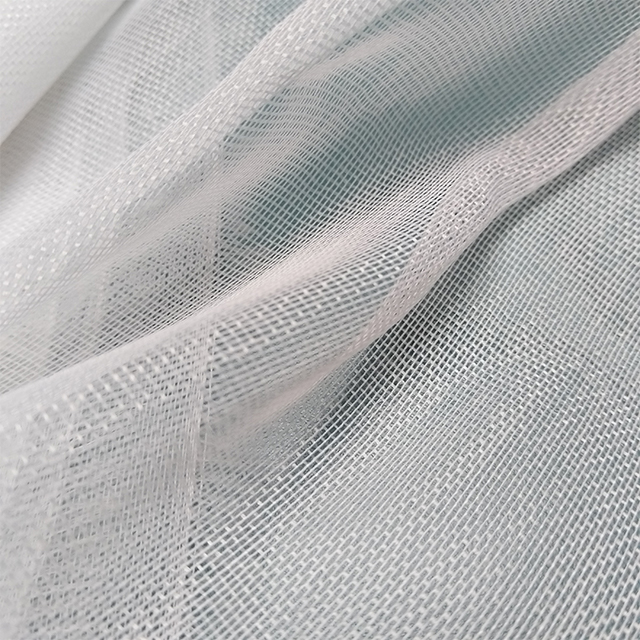
Real-world manufacturing introduces variables you cannot ignore. Roll-to-roll continuous lamination demands strict process control. Tension control stands as your foremost priority during these operations. If web tension loses precise calibration, you invite severe manufacturing defects.
The highest risk involves "necking." Necking occurs when excessive machine-direction tension pulls the grid longitudinally. The cross-directional yarns buckle inward. This distorts the square mesh into irregular diamonds. Such mesh distortion completely ruins uniform product quality. You must utilize sensitive load cells and dancer rollers to maintain stable tension.
Managing strike-through presents a secondary process challenge. Strike-through happens when too much adhesive bleeds through the mesh openings. You must carefully match your mesh size to the viscosity of your resin. Engineers measure mesh size in ends per inch (EPI). A highly viscous adhesive requires a wider EPI. A watery resin needs a tighter EPI to hold the fluid.
Proper matching prevents unwanted bleed-through while ensuring necessary mechanical interlocking. The resin must wrap around the yarns without dripping through the opposite side. Finding this viscosity-to-mesh ratio requires rigorous empirical testing.
Finally, respect the thermal limits of your polymers. High-heat curing processes push synthetic yarns to their physical extremes. Standard polyester maintains stability at moderate temperatures. However, extreme heat thresholds demand specialized interventions. When curing exceeds specific temperature boundaries, standard yarns undergo thermal shrinkage. For rigorous high-heat applications, always specify specialized thermal coatings to lock the dimensional structure in place.
Various industries rely heavily on the unique properties of laid mesh grids. Their versatility solves diverse engineering problems across entirely different sectors. We see consistent success when deploying these materials in three distinct application categories.
Flexible Composites & Tapes: Manufacturers use industrial laminate mesh to reinforce double-sided adhesive tapes. They also integrate it into heavy-duty packaging materials. The open grid delivers exceptional reinforcement without compromising necessary flexibility. Tapes can bend around sharp corners without tearing or losing adhesive tack.
Building & Construction: Construction environments punish materials relentlessly. Vapor barriers, roofing membranes, and flooring underlayments require extreme durability. Moisture resistance and dimensional stability remain absolutely non-negotiable here. A laid grid prevents roofing membranes from expanding under intense summer heat. It also stops sub-floor moisture from warping expensive underlayments.
Specialty Substrates: Niche markets demand specialized structural integrity. Leather bonding composites utilize these grids to merge thin, genuine leather layers. Automotive interior trims also depend on them. In automotive applications, superior tear resistance remains critical for longevity. A reinforced dashboard or seat cover resists daily friction and wear.
Finding the right supplier dictates your overall production success. Off-the-shelf specifications rarely fit optimized, high-speed production lines perfectly. You need a partner capable of executing strict customization capabilities. Look for suppliers offering specific custom widths. Demand tailored grid patterns and customized binder chemistry treatments.
Do not compromise on quality assurance. Certifications prove a supplier operates with discipline. Prioritize vendors holding ISO certifications. Ask for proof of standardized tensile testing protocols. They should utilize universally accepted methods like ASTM standards to verify yarn strength. Batch-to-batch consistency prevents sudden failures on your lamination line.
Evaluation Area | What to Verify | Why It Matters |
|---|---|---|
Customization | Custom widths and EPI configurations | Reduces edge-trim waste and optimizes bonding |
Chemistry | Proprietary binder matching | Prevents delamination across different resins |
Compliance | ISO 9001 and ASTM testing | Ensures batch-to-batch structural reliability |
Once you identify a promising supplier, initiate strict next-step actions. Never commit to bulk orders blindly. First, request physical sample rolls. Second, conduct rigorous in-house peel-strength testing. Finally, run comprehensive pilot line trials. Monitor web tension, resin strike-through, and thermal stability during these trials. Only proceed to full-scale procurement after validating these metrics.
Specifying the perfect reinforcing layer requires balancing structural geometry, polymer chemistry, and process alignment. You cannot treat this material as an afterthought. A well-selected grid actively distributes stress, reduces product thickness, and ensures compatibility with varied adhesive systems.
The right material immediately lowers scrap rates and eliminates costly in-field delamination failures. Proper specification protects your brand reputation and your production margins simultaneously.
Take actionable steps today. Request technical data sheets (TDS) from qualified suppliers. Order a custom sample roll for trial lamination runs. If you face complex integration challenges, contact a materials engineering specialist for a comprehensive specification review.
A: Woven scrims interlace yarns over and under each other. This physical weaving causes crimp and adds undesirable thickness. Laid scrims take a different approach. They chemically bond overlapping yarns at flat intersections. This results in a much flatter, thinner, and dimensionally stable profile.
A: Standard polyester possesses specific thermal thresholds. It typically melts around 250°C. However, thermal shrinkage begins at much lower temperatures. For high-heat lamination, you must carefully evaluate specific heat-set chemical treatments. If temperatures exceed treatment limits, you might need fiberglass alternatives.
A: Mesh size dictates the available open area. Larger mesh openings naturally reduce the surface area available for the adhesive to coat. This potentially lowers your overall adhesive weight and cost. However, larger gaps require careful viscosity control. The adhesive must span wide gaps without falling straight through.


