Jumbo Roll Scrim Backing Fabric

- All
- Product Name
- Product Keyword
- Product Model
- Product Summary
- Product Description
- Multi Field Search
Views: 0 Author: Site Editor Publish Time: 2026-04-23 Origin: Site


In industrial production, the performance of backing materials depends not only on how they are manufactured, but also on how they are stored, handled, and used over time. Even a well-made polyester roll mesh backing material can lose value if it is exposed to poor storage conditions, rough handling, contamination, or unnecessary process stress. At Taixing Cinfudy Textile CO., LTD., we believe that proper maintenance is an important part of getting the most from industrial backing materials.
This is especially true in applications such as lamination, coating, calendaring, composites, flooring, wallcoverings, and insulating tape. In these environments, the backing material must remain stable from storage to line loading and from processing to final conversion. When users want longer service life, lower waste, and more reliable performance, maintenance planning should begin early rather than after problems appear.
Backing materials are sometimes treated as passive support layers, but in reality they play an active role in overall product performance. If the roll becomes contaminated, deformed, or stressed during storage and production, the material may no longer perform as expected. This can affect bonding, dimensional stability, handling efficiency, and finished-product consistency.
A backing material that remains clean, evenly wound, and dimensionally stable is far more likely to support smooth industrial processing. For this reason, maintenance is not only about preserving appearance. It is about protecting structure, usability, and long-term value.
In industrial production, even minor issues can quickly lead to waste. A damaged edge may create alignment problems. Dust on the surface may affect bonding. Unstable tension may reduce dimensional consistency. These problems often begin small, but once production starts, they can spread across a large amount of material.
Longer-lasting backing materials help reduce interruptions and improve consistency. When the material keeps its shape and unwinds smoothly, operators can focus more on production quality and less on correction work. In this sense, longevity is closely connected to line efficiency.
Storage conditions have a direct effect on the usable life of polyester roll mesh backing material. If rolls are stored in poor environments, they may become more difficult to process later even if the material itself was originally produced to a high standard.
We usually recommend storing rolls in a clean, dry, and well-ventilated area. The material should be protected from direct sunlight, excessive heat, moisture, and dust. Polyester is generally stable, but good storage control still helps preserve roll condition and maintain processing reliability.
Heat, humidity, and airborne dust are common risks in industrial environments. Too much environmental exposure can affect roll cleanliness and overall handling condition. A controlled storage area helps protect the material before it ever reaches the production line.
Rolls should not be stacked in a way that creates unnecessary compression. Too much pressure may deform the roll, damage the edges, or make unwinding less stable. Proper storage layout is a simple but important part of material protection.
Handling damage is one of the most common causes of reduced backing-material longevity. Even when the fabric itself is strong, poor movement practices can damage the roll ends, edges, or winding structure.
This is why rolls should always be moved with suitable equipment and supported carefully during loading and unloading. Dragging, dropping, or roughly repositioning rolls can reduce usability long before the material enters production.
Edge condition matters more than many users expect. Flattened, frayed, or compressed edges can lead to feeding problems, uneven running, or extra trimming waste. Good edge protection helps support smoother unwinding and more stable line performance.
The way a roll is handled also affects how well it stays wound. Once winding becomes uneven, the material may be harder to use on downstream equipment. Good handling practices help preserve both the fabric and the roll structure.
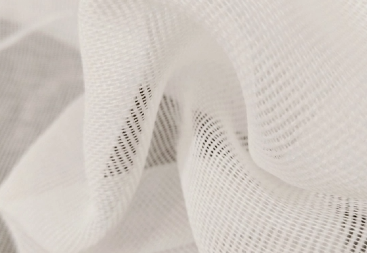
Clean backing material is easier to process and more likely to deliver dependable results. Dust, oil, chemical residue, and surface dirt can interfere with lamination, coating, and bonding performance. In technical products, even a small amount of contamination can create visible or structural defects.
For this reason, polyester roll mesh backing should be protected from unnecessary exposure when not in use. Clean storage and careful line-side handling both help reduce contamination risk.
If the surface is not clean, adhesives or coatings may not behave consistently. This can lead to weak areas, uneven bonding, or finished-product defects that are difficult to trace later.
A clean working environment reduces the chance that foreign material will affect the backing during loading and conversion. In many cases, cleanliness improves both product quality and maintenance efficiency.
Although polyester roll mesh backing material is valued for non-elastic stability, it still needs proper tension control during industrial use. Excessive or unstable tension can cause distortion, edge stress, or irregular feeding.
A well-maintained production setup should keep tension balanced throughout unwinding, feeding, and downstream processing. Smooth transport through the line helps protect the material from unnecessary strain and supports better dimensional stability.
When tension is too high, the material may develop shape irregularities or stress points. These issues can reduce processing quality and shorten the useful life of the backing.
When the line is adjusted correctly, the backing is more likely to hold its structure and support more consistent lamination or coating performance. In practice, tension settings are part of maintenance too.
Industrial polyester roll mesh backing material is often selected because it can perform well in demanding process environments. However, heat resistance does not mean the material should be exposed to unnecessary thermal stress for long periods.
Controlling heat exposure during both storage and production helps maintain dimensional stability and low-shrinkage performance. The goal is not only to avoid damage, but also to preserve reliable long-term behavior.
Rolls should be kept away from direct heat sources and uncontrolled hot areas. Good storage discipline helps the material stay stable before use.
During production, the backing should be exposed only to the amount of heat required by the process. Avoiding unnecessary thermal stress helps protect the material’s structure and performance.
For users who keep multiple rolls in stock, inventory control is another useful part of maintenance. A planned first-in, first-out approach helps reduce unnecessary idle storage and supports more consistent material use.
This does not mean polyester mesh backing lacks storage stability. It simply means that organized stock rotation is a practical way to reduce risk and improve process reliability.
When older rolls are used first, the chance of long idle storage is reduced. This helps maintain better stock discipline and lowers the risk of avoidable storage-related problems.
Well-managed inventory makes it easier to maintain predictable material condition across production batches. This is especially helpful in continuous industrial operations.
Maintenance Area | What to Watch | Why It Matters |
Storage environment | Heat, moisture, dust, sunlight | Helps preserve roll shape and cleanliness |
Roll stacking | Excessive pressure or poor placement | Prevents deformation and edge damage |
Handling method | Dropping, dragging, rough movement | Reduces winding and structural damage |
Surface cleanliness | Dust, oil, residue, contamination | Supports bonding and processing quality |
Tension control | Excessive or unstable line tension | Protects dimensional stability |
Heat exposure | Unnecessary thermal stress | Helps maintain low-shrinkage performance |
Edge protection | Flattening or fraying | Supports smooth unwinding and less waste |
Inventory rotation | Long idle storage | Improves consistency in industrial use |
Maintenance should not be understood only as warehousing or physical protection. It is also part of daily production discipline. The way the backing material is loaded, aligned, tensioned, and monitored affects how well it performs over time.
At Taixing Cinfudy Textile CO., LTD., we often find that the best results come when customers view backing material as part of the full production system rather than as a low-priority input. Longevity is usually not created by one single action. It comes from many small correct actions carried out consistently.
When operators follow careful storage and handling procedures, fewer avoidable problems appear in production. This helps reduce scrap, line interruptions, and quality variation.
A backing material delivers more value when it is protected every day, not only when problems arise. Consistent daily control often makes the biggest difference in service life.
The service life of industrial polyester roll mesh backing material depends on more than manufacturing quality alone. Proper storage, careful handling, surface cleanliness, stable tension control, heat management, edge protection, and planned inventory rotation all help preserve material performance over time. When these factors are managed well, the backing is more likely to remain stable, process smoothly, and support reliable finished-product quality.
At Taixing Cinfudy Textile CO., LTD., we believe that good maintenance is an important part of getting long-term value from polyester roll mesh backing material. For industrial users working in lamination, coating, composites, flooring, wallcoverings, and other technical applications, careful material management can make a real difference in production efficiency and product consistency. Readers who want to learn more can explore further with Taixing Cinfudy Textile CO., LTD.
Q: How should industrial polyester roll mesh backing material be stored?
A: It should be stored in a clean, dry, and well-ventilated area away from moisture, dust, direct sunlight, and excessive heat.
Q: Why is tension control important for polyester roll mesh backing material?
A: Proper tension control helps protect dimensional stability, reduces distortion, and supports smoother performance during industrial processing.
Q: How does cleanliness affect backing material longevity?
A: Clean backing material is less likely to suffer bonding problems, surface defects, or contamination-related quality issues during coating or lamination.
Q: What helps extend the service life of industrial polyester roll mesh backing material?
A: Proper storage, careful handling, edge protection, controlled heat exposure, stable tension, and planned inventory rotation all help improve longevity.


