Jumbo Roll Scrim Backing Fabric

- All
- Product Name
- Product Keyword
- Product Model
- Product Summary
- Product Description
- Multi Field Search
Views: 0 Author: Site Editor Publish Time: 2026-04-16 Origin: Site


In industrial materials manufacturing, performance begins long before the final application stage. It starts with raw material selection, fabric construction, process control, and quality inspection. At Taixing Cinfudy Textile CO., LTD., we believe industrial polyester roll mesh backing should be judged not only by its specifications, but also by how it is made and how consistently it performs from roll to roll.
For many industrial projects, polyester roll mesh backing sits behind the visible surface layer, but it still has a direct impact on production stability and finished product quality. It supports applications such as lamination, coating, calendaring, composites, flooring, wallcoverings, and insulating tape, where dimensional control and reliable processing are essential. A well-manufactured backing helps reduce bonding issues, distortion, shrinkage problems, and line instability, making it an important factor in long-term industrial performance.
Industrial buyers often compare materials by width, weight, or price first. These are important factors, but they do not tell the full story. Two products with similar visible specifications can perform very differently if their manufacturing processes are not controlled to the same standard.
The actual performance of polyester roll mesh backing depends on many production details: yarn quality, weaving consistency, tension control, structure uniformity, roll formation, shrinkage behavior, and inspection discipline. If one of these elements is weak, the whole product may become less reliable in downstream use.
This is especially true in industrial projects that involve heat, pressure, coating, or continuous production. In those environments, backing materials must do more than exist as a base layer. They must remain stable, support bonding, and run consistently across long processing cycles.
The manufacturing process starts with the polyester yarn itself. Good backing performance depends on choosing suitable raw material with stable physical properties. The yarn needs to provide consistent strength, reliable processability, and compatibility with the intended fabric construction.
At this stage, one of the key goals is consistency. If yarn quality varies too much, the woven structure may become uneven, which can later affect mesh regularity, dimensional stability, and the way the fabric behaves during lamination or coating. For industrial polyester roll mesh backing, raw material stability is not a minor detail. It is the first step in controlling final performance.
In our view, a strong quality standard begins before weaving. It begins with disciplined material selection and careful attention to the basic building blocks of the fabric.
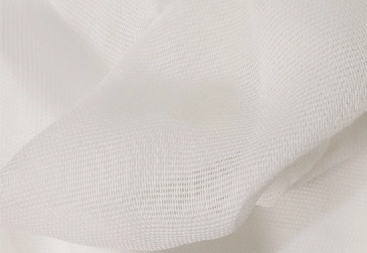
After yarn preparation, the next major stage is weaving. This is where the backing material takes its functional form. A woven mesh backing is valued because it provides organized reinforcement and more predictable structural behavior than an irregular or less controlled base.
The weaving stage determines the pattern, density, balance, and overall uniformity of the fabric. In industrial applications, woven consistency matters greatly. If the construction varies too much across the roll, it can create uneven handling, tension problems, or variable bonding behavior during downstream processes.
A good industrial polyester roll mesh backing should show a stable and repeatable structure. This supports better converting performance and makes the material easier to integrate into continuous manufacturing systems. From our perspective, weaving is not just about making fabric. It is about creating a controlled industrial substrate.
Once weaving begins, process control becomes one of the most important parts of manufacturing. Even with good raw materials and a suitable design, poor production control can reduce performance quality.
Several things must be controlled carefully during production:
fabric tension,
dimensional consistency,
structural uniformity,
roll winding quality,
and surface cleanliness.
If the fabric is produced under unstable tension, it may develop shape irregularities. If winding is not controlled properly, the roll may become difficult to use in downstream equipment. If structural consistency is weak, the final material may behave unpredictably during lamination or coating.
For industrial polyester roll mesh backing, production control is directly linked to usability. A well-controlled fabric does not just pass inspection more easily. It performs better on the customer’s line.
One of the most important quality expectations for industrial polyester mesh backing is low shrinkage. In industrial use, the material may pass through heated processes, pressured systems, or long continuous runs. If the backing changes dimension too much, the finished product may lose consistency.
That is why shrinkage control must be considered throughout manufacturing, not only during final inspection. Material selection, weaving balance, and process stability all contribute to dimensional behavior. A backing material with good low-shrinkage performance supports better quality in coated and laminated products, especially in applications where size retention is critical.
Closely related to shrinkage is non-elastic stability. In many industrial projects, controlled stability is more valuable than stretch. A backing that stays stable under processing conditions helps manufacturers reduce distortion and improve finished product uniformity.
Another important part of the manufacturing process is roll formation. For industrial users, the backing material is not only judged by the fabric itself, but also by how it is supplied. A poorly formed roll can create handling problems even when the material quality is otherwise acceptable.
Industrial polyester roll mesh backing is often preferred in jumbo roll format because it supports longer continuous production runs. Longer rolls reduce the number of roll changes, lower seam frequency, and help improve efficiency. To deliver this advantage properly, roll winding must be controlled so that the finished roll is even, stable, and practical for industrial handling.
This stage may look simple, but it has real value. A high-quality jumbo roll should support smooth unwinding, minimize interruptions, and help the customer maintain production flow. In industrial manufacturing, roll quality is part of product quality.
When customers review industrial polyester roll mesh backing, they usually focus on both visible and performance-based standards. Below is a practical summary of the key quality areas that matter most.
Quality Standard | Why It Matters | What Good Performance Looks Like |
Raw material consistency | Affects overall fabric stability | Uniform polyester yarn quality |
Weaving uniformity | Influences handling and reinforcement | Balanced and repeatable mesh structure |
Dimensional stability | Supports product precision | Minimal distortion during processing |
Low shrinkage | Reduces heat-related variation | Reliable size retention |
Non-elastic behavior | Helps line control | Stable performance under tension |
Roll formation | Affects usability on the line | Even jumbo roll winding and smooth unwinding |
Surface cleanliness | Supports downstream bonding | Clean fabric without excessive defects |
Inspection control | Confirms batch reliability | Consistent quality from roll to roll |
No manufacturing process is complete without inspection. In our view, quality standards must be confirmed, not assumed. Inspection is the stage where production results are checked against practical performance expectations.
For industrial polyester roll mesh backing, quality control should not focus only on visual appearance. It should also consider whether the material is suitable for real converting conditions. A fabric may look acceptable but still perform poorly if shrinkage, tension response, or winding quality are inconsistent.
This is why inspection should cover multiple dimensions of quality, including structure, roll condition, dimensional consistency, and overall production stability. The goal is not simply to remove defective rolls. The goal is to deliver material that supports reliable industrial use.
A strong inspection mindset also helps prevent repeat problems. When quality control is part of the production culture, not only the final step, manufacturers are better able to maintain consistency across different batches and customer requirements.
Different industrial applications place different demands on polyester roll mesh backing, but all of them benefit from stable quality standards. In wallcoverings and wall panels, the backing helps support shape and processing consistency. In flooring materials, dimensional stability is especially important. In coated fabrics and laminated composites, backing structure influences both handling and bonding support.
If the quality standard is not controlled, downstream users may experience problems that are difficult and expensive to correct later. These may include waste during production, inconsistent finished dimensions, weaker bonding areas, or line stoppages caused by poor roll performance.
This is why we often encourage customers to ask not only what the product specification is, but also how the product is manufactured and how quality is controlled. Industrial backing materials should be chosen with a full-process mindset.
When selecting industrial polyester roll mesh backing, the supplier’s manufacturing discipline matters as much as the fabric specification. A good supplier should understand how the product will be used, not just how it will be sold. This means paying attention to raw material control, weaving stability, jumbo roll production, and inspection standards.
At Taixing Cinfudy Textile CO., LTD., we believe customers benefit most when the backing material is developed with both manufacturing efficiency and application performance in mind. Industrial users do not simply need a woven polyester mesh. They need a backing material that can perform consistently in real production conditions and support the demands of their specific project.
The value of industrial polyester roll mesh backing depends heavily on its manufacturing process and quality standards. Good performance begins with suitable polyester yarn, continues through controlled weaving and process management, and is confirmed through disciplined inspection. Properties such as low shrinkage, non-elastic stability, structural uniformity, and reliable jumbo roll formation are not accidental. They are the result of careful manufacturing control.
At Taixing Cinfudy Textile CO., LTD., we see high-quality polyester roll mesh backing as a practical foundation for better industrial products and more efficient processing. For companies working in lamination, coating, composites, flooring, wallcoverings, and other technical fields, understanding how backing materials are made is an important part of making the right sourcing decision. Readers who want to learn more about suitable solutions can explore further with Taixing Cinfudy Textile CO., LTD.
Q: What is industrial polyester roll mesh backing used for?
A: It is used in applications such as lamination, coating, composites, flooring, wallcoverings, and technical tapes where stable backing support is needed.
Q: Why is low shrinkage important in polyester mesh backing manufacturing?
A: Low shrinkage helps the backing keep stable dimensions during heat and processing, which improves final product consistency.
Q: How does the manufacturing process affect polyester roll mesh backing quality?
A: It affects yarn consistency, weaving uniformity, dimensional stability, roll quality, and how reliably the material performs in industrial production.
Q: What quality standards should buyers check for industrial polyester roll mesh backing?
A: Buyers should focus on raw material consistency, woven structure, low shrinkage, non-elastic stability, roll formation, and inspection control.


