Jumbo Roll Scrim Backing Fabric

- All
- Product Name
- Product Keyword
- Product Model
- Product Summary
- Product Description
- Multi Field Search
Views: 0 Author: Site Editor Publish Time: 2026-06-08 Origin: Site


Industrial lamination and tape manufacturing often face critical failure points during production. Delamination ruins product integrity and forces costly material scrap. Dimensional instability causes warping during automated processing. Poor tear resistance leads to catastrophic failures in the field. These structural issues hurt your bottom line and severely damage brand reputation. You need a reliable, engineered solution to prevent these mechanical breakdowns. Engineers consistently turn to polyester scrim backing cloth to solve these rigorous challenges. It acts as a dedicated structural layer inside the final product. It reinforces delicate films without adding excessive weight or bulky thickness. Choosing the right reinforcement material is essential for long-term production success. Selecting the proper mesh requires aligning specific physical properties to your unique manufacturing processes. You must evaluate yarn denier, grid density, and binder chemistry carefully. We will explore how to match these technical elements to your distinct end-use performance requirements. You will learn to optimize strength, reduce production waste, and improve overall product quality.
Polyester scrim backing cloth provides an optimal strength-to-weight ratio, ensuring dimensional stability in high-stress lamination processes.
Success depends on matching the composite base material binder type to your specific adhesive or resin system to prevent chemical incompatibility.
Key evaluation metrics for procurement include tensile strength, elongation limits, thermal stability, and grid density (threads per inch).
Supplier selection should prioritize those offering technical data sheets (TDS), custom roll widths, and consistent greige or finished quality.
Standard woven fabrics present distinct challenges in precision manufacturing environments. They often add too much bulk to the final product. Sometimes they lack the open-mesh structure required for highly viscous resins and adhesives to strike through effectively. This creates weak interlaminar bonds. Conversely, using completely unreinforced films poses significant risks during everyday use. A tiny puncture can easily result in catastrophic tear propagation across the entire film surface.
Manufacturers solve this dilemma by integrating a lightweight skeleton into the laminate. The scrim provides critical structural support without dominating the material profile. Its open grid allows superior chemical or mechanical bonding between the top and bottom substrate layers. Meanwhile, the high-tenacity polyester yarns absorb intense mechanical stress before it ruptures the outer films.
To measure manufacturing success, you should track these Key Performance Indicators (KPIs):
Tear Propagation Resistance: This vital metric stops minor punctures from developing into full-length tears. It is critical for outdoor textiles.
Dimensional Stability: This prevents unwanted stretching or warping. It keeps materials aligned perfectly during automated web handling.
Thickness Control: This maintains ultra-thin profiles necessary for precision applications, ensuring the final roll does not become excessively large.
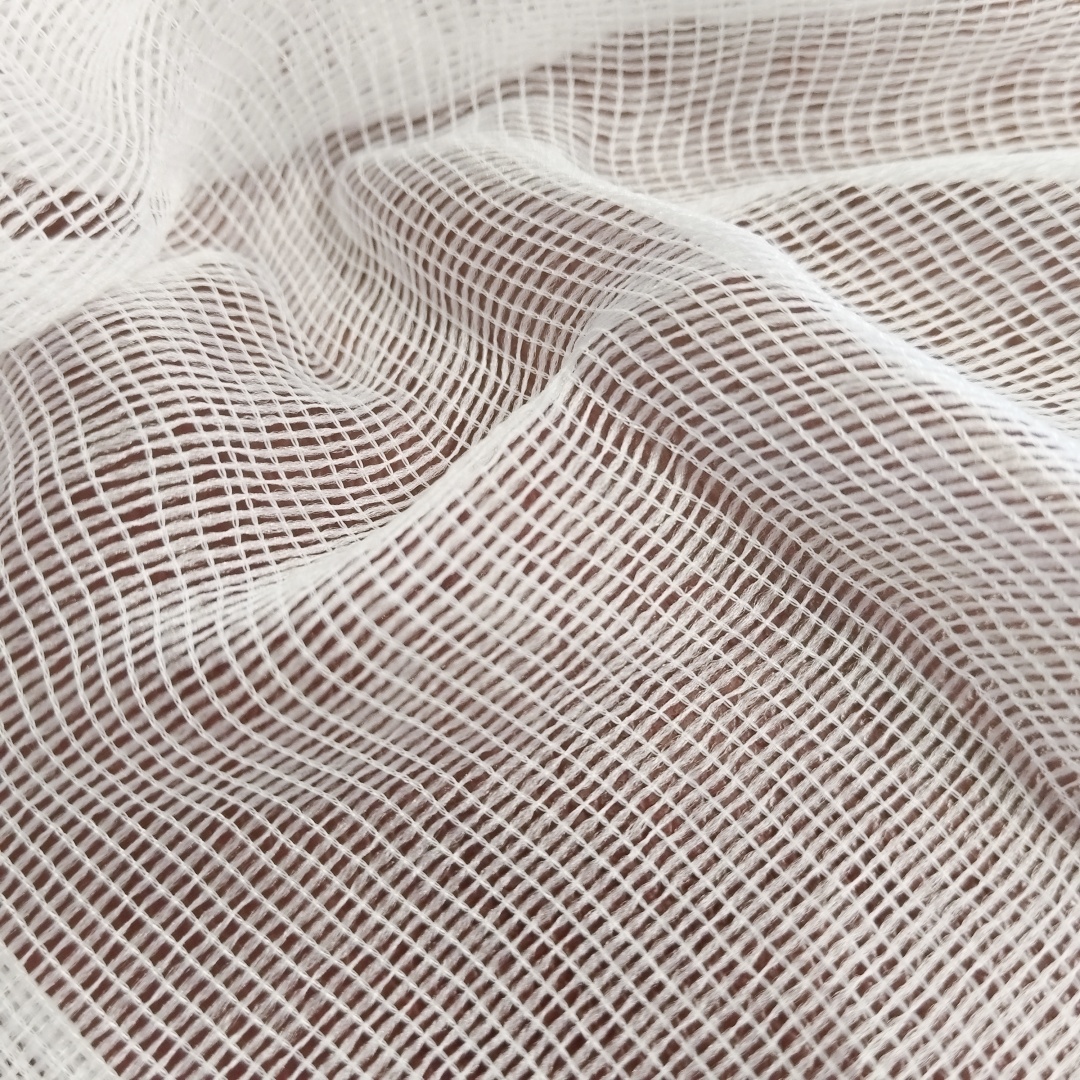
Different end products require highly specific performance traits from a scrim backing fabric. You must align the material properties directly to your targeted output to guarantee field reliability.
Producing reliable, industrial-grade tapes requires meticulous material selection.
Requirements: The base layer demands high flexibility and minimal elongation under pulling tension. It also requires incredibly strong adhesion to pressure-sensitive adhesives (PSAs).
Outcomes: This careful alignment produces heavy-duty duct tapes. It creates reliable double-sided industrial tapes and highly reinforced packaging tapes used in global shipping.
Heavy-duty outdoor and industrial applications rely heavily on robust industrial laminate cloth to survive harsh environments.
Requirements: The fabric must exhibit exceptional heat resistance. It must withstand the intense temperatures of the extrusion or hot-melt lamination process. It also needs strict chemical compatibility with PVC, TPU, or PE films.
Outcomes: Manufacturers use this material to create rugged tarpaulins and large-format billboard banners. It also reinforces flexible roofing membranes and high-performance marine sailcloth.
Building materials operate in demanding environmental conditions over decades.
Requirements: Reinforcements need strong alkali resistance, especially if placed near wet concrete. They must offer excellent moisture resistance to prevent mold growth. They also require high acoustic and thermal compatibility for building codes.
Outcomes: This specific alignment translates into durable LVT/SPC flooring reinforcement that prevents tile cracking. It serves as strong HVAC duct wrap backing and highly effective fiberglass insulation facing.
Evaluating a composite base material requires understanding its core engineering metrics. You cannot rely on visual inspection alone when structural integrity is at stake.
You must evaluate both the thickness and the tensile strength of the polyester yarn. Denier measures the linear mass density of the fibers. Higher denier yields superior tensile strength, which handles heavier loads. However, higher denier directly increases the overall material thickness. You must carefully balance raw strength against your required profile limits.
Manufacturers measure grid density via Ends Per Inch (warp) and Picks Per Inch (weft). Tighter meshes offer more surface area for bonding adhesives. However, looser meshes allow much better resin strike-through for thicker polymers. Your choice depends entirely on your specific adhesive viscosity and application method.
Fabric construction methods heavily dictate physical performance under stress.
Laid Scrim: Yarns are chemically bonded at intersections rather than interlaced. This method offers much flatter profiles. It provides significantly higher dimensional stability under tension, making it ideal for high-speed production lines.
Woven Scrim: Yarns are mechanically interlaced using traditional loom methods. This usually provides higher peak tear resistance. However, it may suffer from severe grid distortion if not properly finished or tensioned during lamination.
Binder chemistry is absolutely crucial for structural adhesion. You must analyze the chemical coating applied to the raw cloth. Common coatings include PVA, PVC, or Acrylic formulas. This binder must chemically bond perfectly with the secondary resin or adhesive used in your facility. If they clash, the entire composite will fail.
Performance Feature | Laid Scrim Construction | Woven Scrim Construction |
|---|---|---|
Intersection Bond Type | Chemical Binder Formulation | Mechanical Interlacing |
Profile Thickness | Very Flat / Ultra-thin | Thicker / Bulky Profile |
Dimensional Stability | Excellent Stability | Moderate (Requires Finishing) |
Peak Tear Resistance | Moderate to High | Exceptional |
Integrating a new reinforcement mesh into an existing production line introduces specific operational risks. Recognizing these hazards early prevents costly production downtime and excessive material waste.
Polyester naturally shrinks when exposed to high heat. Procurement teams must verify the material's specific thermal shrinkage percentage. Extrusion coating processes often exceed 200 degrees Celsius. If ignored, the final laminate will warp severely as it cools. Always request comprehensive thermal testing data before initiating large-scale runs.
This remains a catastrophic failure mode in composites manufacturing. If the scrim's binder repels your laminating adhesive, structural failure becomes inevitable. The layers will separate easily under minimal stress. Assumption transparency: You should never assume chemical compatibility based on generic specifications. Always mandate small-scale pilot runs before initiating full-scale integration.
Poorly finished fabric edges cause massive operational headaches. Edge fraying during continuous roll-to-roll processing routinely causes automated machine jams. It ruins expensive materials and halts production schedules. You must carefully assess the supplier's edge-trimming techniques and their overall winding quality before purchasing.
Selecting a vendor goes far beyond comparing simple unit prices. You need a dedicated partner capable of providing precise engineering support and consistent material delivery.
Can the supplier adjust the mesh size easily? Will they modify the roll width to match your exact machinery? Can they alter the binder type to fit your proprietary production lines? True manufacturing partners adapt their processes to yours. They do not force you into inefficient standard constraints.
You need strict quality control to maintain your own product standards. Look for suppliers holding recognized ISO certifications. Prioritize those who readily provide lot-to-lot testing data. They should document tensile strength, elongation limits, and exact grammage (GSM) for every shipment.
Determine your exact facility requirements early in the sourcing phase. Do you need raw polyester greige to apply your own specialized chemical treatments? Or do you require fully finished, ready-to-laminate fabric? Clarifying this crucial step drastically reduces miscommunications and supply chain delays.
Never commit to large volumes without physical verification. Request a Technical Data Sheet (TDS) immediately. Ask for an A4 sample or a small pilot roll. Conduct internal peel-strength tests and rigorous thermal stability testing before issuing a formal purchase order.
Selecting the optimal polyester scrim backing cloth is a highly precise engineering decision. This single choice directly dictates the durability of your final laminated product. It determines the ultimate weight and controls the overall field failure rate. We strongly recommend basing your procurement decisions on empirical testing. Always prioritize binder compatibility and thermal stability over simple unit price comparisons. Proper material alignment guarantees a structurally sound, highly profitable end product. Contact our engineering team today. We encourage you to request material samples and carefully compare TDS specifications. Let us discuss custom laid-scrim solutions perfectly tailored for your specific lamination line.
A: Laid scrim uses a chemical binder to hold intersecting yarns flat, providing a thinner profile and better dimensional stability. Woven scrim physically interlaces the yarns, which can create a thicker profile but superior mechanical tear resistance.
A: Polyester offers higher flexibility, better elongation recovery, and is less brittle than fiberglass, making it ideal for flexible laminates and tapes. Fiberglass is superior for rigid composites requiring extreme heat resistance.
A: Yes, provided the scrim is coated with a compatible binder (such as certain acrylics or PVAs) that promotes adhesion with water-based systems without degrading the yarn.
A: While standard widths often range from 1 to 3 meters, industrial suppliers typically offer custom slitting to match exact manufacturing web widths, minimizing waste.


