Jumbo Roll Scrim Backing Fabric

- All
- Product Name
- Product Keyword
- Product Model
- Product Summary
- Product Description
- Multi Field Search
Views: 0 Author: Site Editor Publish Time: 2026-09-03 Origin: Site


In industrial manufacturing and composite engineering, structural integrity relies heavily on the reinforcement layer. Selecting the incorrect base material leads to delamination, dimensional distortion, or premature mechanical failure. Engineers and procurement teams frequently face a choice between standard woven polyester scrims and knitted variants. Misunderstanding the behavioral differences in stretch, stability, and resin uptake causes production errors, particularly in high-stakes applications like military textiles or commercial wallcoverings. This guide provides a technical breakdown of polyester scrim fabric compared to knitted variants. We evaluate both materials across structural stability, conformability, application suitability, and implementation risks. You will see exactly how these textiles perform under tension, during lamination, and in the field. We skip the theory and focus on the mechanical realities that dictate whether your final composite holds together or fails under load.
Structural Priority: Standard woven polyester scrim fabric prioritizes high tensile strength and rigid dimensional stability, making it ideal for flat, high-tension applications.
Conformability Advantage: Knitted polyester scrim utilizes continuous fiber loops, offering superior flexibility and elongation for complex, curved, or dynamic structures.
The "Same Face, Different Backing" Rule: The choice of scrim backing fundamentally alters the behavior of the top layer; applying the exact same vinyl face to a woven versus a knitted backing yields totally different stretch, stability, and installation results.
Risk Mitigation: Selecting the wrong scrim type introduces severe implementation risks, including adhesive failure, edge fraying during processing, or structural fatigue under load.
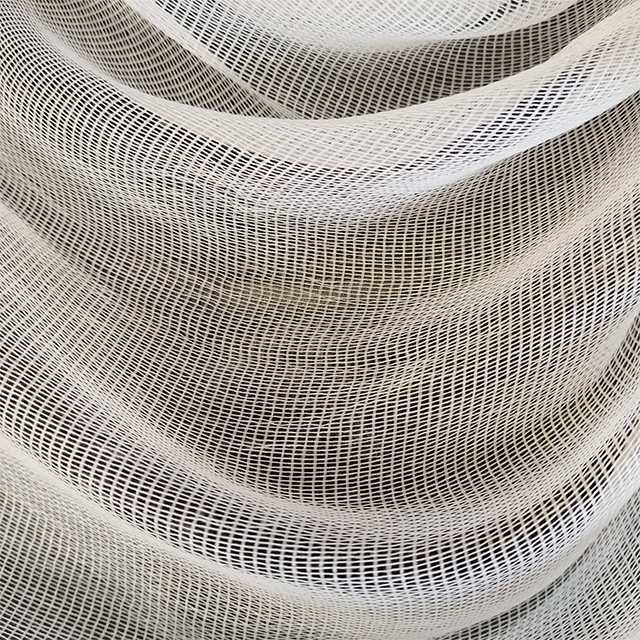
Establishing the baseline mechanical requirements for reinforcement fabrics in composite and lamination processes requires understanding polymer science and textile engineering. Industrial scrims utilize high-tenacity continuous filament polyester rather than spun polyester. Continuous filaments provide uninterrupted load-bearing capabilities across the entire length and width of the material. Spun yarns possess weak points where individual fibers overlap. By utilizing continuous high-tenacity extrusion, manufacturers maximize the tensile strength, chemical resistance, and long-term durability of the reinforcement layer. We see this daily on the production floor. When you run a 1000-denier continuous filament through a coating line, it handles the tension. Spun yarns snap, causing line stops and wasted material.
Standard woven scrim is a lightweight, open-weave material utilizing intersecting warp (lengthwise) and weft (crosswise) yarns. These yarns cross each other at rigid 90-degree angles, creating a grid-like structure. Because the yarns merely rest on top of one another at the intersections, the structure is inherently unstable on its own. To resolve this, manufacturers apply chemical binders. We typically see polyvinyl alcohol (PVA), polyvinyl chloride (PVC), or acrylic formulations used here. These binders lock the intersections in place, preventing the yarns from shifting during secondary processing.
This specific construction creates a polyester woven mesh that functions exceptionally well in providing rigid, multi-directional reinforcement. The open spaces between the yarns allow adhesives, resins, or thermoplastic coatings to strike through and encapsulate the grid. This creates a highly stable composite matrix. If you are building a flat roofing membrane, this grid keeps the PVC topcoat from stretching out of shape under the summer sun.
The warp-knitting process constructs the fabric using continuous fibers interlocked in a series of loops rather than a rigid over-under weave. A specialized knitting machine uses hundreds of needles to simultaneously form loops in the lengthwise direction while inserting weft yarns across the width. The resulting structure features yarns that are mechanically entangled rather than chemically bonded at their intersections.
The absence of rigid, binder-locked intersections allows the yarns to shift and stretch slightly without breaking the structural matrix. This interlocking loop architecture gives knitted polyester scrim its defining characteristic: mechanical give. The loops elongate under stress before the actual polyester filaments begin to bear the maximum tensile load. This provides a buffer against sudden impact or dynamic flexing. When we test these in the lab, the knitted samples absorb shock loads that would instantly snap a woven grid of the same weight.
To fully contextualize these materials, we must distinguish both woven and knitted scrims from nonwoven backings. Nonwoven fabrics consist of randomly oriented fibers bonded together through heat, chemical adhesives, or mechanical entanglement like needle-punching. While nonwovens offer excellent uniform surface coverage and a smooth face for thin laminates, they lack targeted, directional tensile strength. Scrims provide superior tear resistance and load-bearing capacity at a fraction of the weight. If you need structural reinforcement, you specify a scrim. If you just need a smooth surface for a thin veneer, you might look at a nonwoven.
The engineering distinction between woven and knitted structures dictates how the final composite material behaves in the field. Procurement decisions must align with the specific physical demands of the end-use environment. We evaluate these materials across three primary dimensions.
Woven structures exhibit linear load distribution. Because the warp and weft yarns are laid out in straight lines, any tension applied along the X or Y axis transfers immediately to the high-tenacity polyester filaments. This makes woven materials highly resistant to stretching. However, this rigidity means that off-axis forces can cause the grid to distort if the binder fails.
Knitted structures rely on multi-directional load distribution. The interlocking loops act like microscopic springs. When tension is applied, the loops pull tight and align before the actual polyester fibers bear the maximum tensile load. This mechanical give allows the material to absorb shock and distribute stress across a wider area. It prevents localized failure under dynamic conditions.
Woven polyester scrim yields superior dimensional stability and higher immediate tensile strength per unit of weight. If an application requires a material to remain perfectly flat and resist elongation under constant tension, a woven construction is mandatory. Think of industrial conveyor belts or tensioned architectural structures. The trade-off is tear propagation. If a woven material is punctured, the linear yarns can continue to unravel or unzip along the tear line. There is no mechanical barrier to stop the separation.
Knitted structures excel in tear resistance. The interlocking loops isolate damage. If a puncture occurs, the surrounding loops tighten around the defect, actively resisting tear propagation. While a knitted fabric may have a slightly lower initial tensile modulus compared to a woven equivalent of the same weight, its ability to survive punctures makes it invaluable in rugged environments.
Elongation-at-break metrics clearly separate the two technologies. A standard woven scrim typically exhibits very low elongation, often breaking at 15% to 20% stretch depending on the yarn denier. A knitted variant can be engineered to stretch significantly more, accommodating complex geometries.
Knitted polyester scrim is mandatory for applications requiring the material to conform to intricate, curved, or thermoformed shapes without wrinkling. When laminating over a 3D mold or wrapping a curved architectural feature, a woven scrim will buckle and fold. This creates unacceptable surface defects. The knitted loops allow the reinforcement layer to expand and compress as needed to match the contour perfectly.
To evaluate conformability in your own facility, follow these testing steps:
Cut a 12-inch by 12-inch square of both the woven and knitted samples.
Apply a standard lamination adhesive to the back of a flexible vinyl face.
Press the scrim into the adhesive and allow it to cure for 24 hours.
Attempt to stretch the composite over a 90-degree outside corner and a spherical mold.
Observe the surface for buckling, wrinkling, or adhesive delamination.
Performance Metric | Woven Polyester Scrim | Knitted Polyester Scrim |
|---|---|---|
Load Distribution | Linear (Immediate load bearing) | Multi-directional (Absorbs initial shock) |
Dimensional Stability | Exceptional (Highly rigid) | Moderate (Allows for mechanical give) |
Tear Resistance | Prone to linear tear propagation | High (Loops isolate and contain punctures) |
Conformability | Poor (Wrinkles on curved surfaces) | Excellent (Adapts to 3D geometries) |
Binder Requirement | Mandatory (To lock intersections) | Optional (Structure is mechanically stable) |
Theoretical structural differences translate directly into field performance. Selecting the correct reinforcement layer dictates whether a product succeeds or fails during installation and daily use.
Commercial wallcoverings require precise handling during installation. Installers manipulate heavy vinyl sheets, align complex printed patterns, and ensure tight seams across expansive wall surfaces. Using the incorrect backing leads to poor seam alignment, severe bubbling, and eventual adhesive failure.
The "Same Face" phenomenon is a reality in this sector. Laminating the exact same 15-ounce vinyl face to a woven scrim versus a poly knit backing results in entirely different installation behaviors. When an installer applies tension to a woven backing, the material fights back. It refuses to stretch, making it incredibly difficult to manipulate around outside corners or over uneven drywall. However, this rigidity provides superior impact resistance for high-traffic corridors where carts and equipment frequently strike the walls.
Conversely, utilizing a knitted vinyl wallcovering scrim backing provides the necessary give for installers. The loops allow the vinyl to stretch slightly, enabling perfect pattern matching even if the wall is out of plumb. The knitted structure also absorbs the stress of the building settling over time, preventing the vinyl from cracking or splitting at the seams.
Military and aerospace applications involve extreme environmental stress and dynamic loading. Materials used in tactical gear, flexible radomes, inflatable structures, and aerospace composites cannot afford catastrophic failure in the field.
Knitted polyester scrims are heavily favored in these environments. The continuous fiber loop construction prevents catastrophic tear propagation under ballistic impact or severe environmental stress. If shrapnel punctures a flexible military shelter, the knitted reinforcement ensures the hole remains localized rather than tearing open across the entire panel. Furthermore, the inherent flexibility of knitted materials allows for repeated folding and deployment without causing fatigue fractures in the polymer coating.
Manufacturing industrial tapes, filtration media, and flexible laminates requires consistent resin penetration and high delamination resistance. The reinforcement layer must integrate seamlessly with the chemical matrix without creating weak boundary layers.
The open-weave nature of a woven scrim backing allows for optimal adhesive strike-through. In tape manufacturing, the adhesive must flow through the mesh to bond the top face to the substrate securely. Woven materials can be engineered with precise openness factors, measured in ends and picks per inch, to control exactly how much resin or adhesive penetrates the layer. This precise control prevents dry spots and ensures uniform peel adhesion across the entire composite roll. We frequently adjust the pick count on the loom to dial in the exact porosity required for a specific viscosity of silicone or acrylic adhesive.
Evaluating the manufacturing implications of your scrim selection is just as important as analyzing the physical performance. Production line speeds, coating compatibility, and defect rates heavily influence the final procurement decision.
The manufacturing speed of warp-knitted scrims generally outpaces traditional weaving. Knitting machines process continuous filaments at high velocities, producing wide-width rolls rapidly. This efficiency provides a high-yield option for large-scale production runs. When manufacturing millions of square yards of flexible ducting or agricultural covers, the speed of warp knitting translates into significant production advantages.
Roll width, thickness consistency, and grams per square meter (GSM) directly impact shipping density and production line speeds. Woven materials, due to their rigid intersections and binder coatings, can sometimes exhibit slight thickness variations at the yarn crossover points. Knitted materials tend to lay flatter, allowing for smoother tension control as the master rolls feed into lamination machines or coating baths.
The physical geometry of the fabric alters how it interacts with secondary coatings like PVC, polyurethane, or silicone. Compare the surface area of knitted loops to flat woven intersections. Knitted structures present a highly textured, three-dimensional surface. This topography provides excellent mechanical keying, allowing thick coatings to grip the loops securely. However, it also means knitted fabrics absorb more resin, potentially increasing the weight of the final composite.
Woven scrims rely heavily on the chemical compatibility of their binder. If a woven scrim is coated with a PVA binder, the secondary lamination adhesive must be chemically compatible with PVA to achieve a permanent bond. Specifying the wrong binder chemistry results in immediate delamination. The coating sticks to the binder rather than the polyester fibers, eventually peeling away under stress.
Processing raw scrims introduces specific manufacturing risks that must be mitigated through precise material specification.
Edge fraying and unravelling during slitting is highly common in woven scrims that lack sufficient binder or utilize an overly open weave. As rotary blades cut the master roll, loose yarns fall away, contaminating the production line and weakening the edges of the final product.
To mitigate fraying, specify a robust binder chemistry tailored to your cutting equipment, or opt for warp-knitted structures that inherently resist unravelling due to their interlocked loops.
Strike-through defects occur when too much adhesive or liquid resin penetrates the scrim, bleeding through to the aesthetic face of a laminate and ruining the visual finish.
To mitigate strike-through, precisely calculate the required openness factor of the woven mesh. Adjusting the yarn count per inch allows engineers to create a physical barrier that restricts fluid flow while providing adequate mechanical reinforcement.
Selecting the optimal reinforcement layer requires matching the material's inherent mechanical properties to the stresses of the manufacturing process and the end-use environment.
The application demands zero stretch and absolute dimensional stability across large surface areas, such as commercial roofing membranes, high-performance sailcloth, or rigid structural laminates.
High initial tensile strength and high modulus are the primary engineering requirements to prevent material deformation under static loads.
The manufacturing process involves flat-line lamination under high tension, where any material stretching causes the final composite to curl or warp upon cooling.
Precise control over adhesive strike-through is required, necessitating a rigid, grid-like structure with specific openness factors.
The final product must conform to complex, 3D, or curved geometries without wrinkling, buckling, or surface distortion.
Tear resistance and the prevention of tear propagation outweigh the need for absolute dimensional rigidity, as seen in military fabrics, inflatable structures, and heavy-duty tarpaulins.
The application involves dynamic flexing, vibration, or repeated folding, requiring a material that absorbs mechanical shock without fatiguing.
Installers require mechanical give to manipulate the material during application, such as in commercial wallcoverings or automotive interior wrapping.
Request technical data sheets (TDS) for both woven and knitted variants from your manufacturer to verify elongation limits and tear-strength minimums.
Order physical sample rolls and conduct in-house adhesion and tensile testing under your specific lamination or coating conditions.
Perform a mock installation on a curved or 3D surface to evaluate conformability and wrinkle resistance before committing to a full-scale production run.
Verify the chemical compatibility of the scrim binder with your secondary adhesives to prevent long-term delamination in the field.
A: A scrim backing provides essential tensile strength and prevents the heavy vinyl face from tearing. It dictates how the wallcovering stretches and stabilizes during installation. The backing fundamentally changes how the vinyl face behaves on the wall, determining whether installers can manipulate the material around corners or match intricate patterns on uneven surfaces.
A: A knitted polyester scrim uses continuous interlocking loops, which provide inherent flexibility, mechanical give, and stretch. A woven polyester mesh utilizes intersecting warp and weft yarns locked at 90-degree angles, creating a highly rigid structure that prioritizes dimensional stability and resists stretching.
A: Knitted polyester scrim is preferred because its continuous fiber loop structure naturally resists tear propagation. If the fabric is punctured by shrapnel or environmental hazards, the interlocking loops tighten around the damage, preventing the tear from spreading. It also offers the flexibility needed for dynamic, high-stress environments like inflatable shelters.
A: Generally, no. Woven polyester scrim fabric possesses rigid dimensional stability that prevents it from stretching or conforming to 3D shapes. If forced over a curved or thermoformed surface, the rigid grid will buckle, fold, and create unacceptable wrinkles in the final composite material.
A: Binders are chemical coatings like PVA, PVC, or acrylic applied to woven meshes to lock the intersecting warp and weft yarns in place. Without the binder, the loose yarns would shift, distort, or fray during slitting and secondary processing, compromising the structural integrity of the open-weave material.
A: It does not necessarily require different chemical adhesives, but the application weight and viscosity must be adjusted. The three-dimensional loops of a knitted backing create a larger surface area and different porosity compared to flat woven intersections, often requiring more adhesive to achieve full wet-out and secure mechanical bonding.


